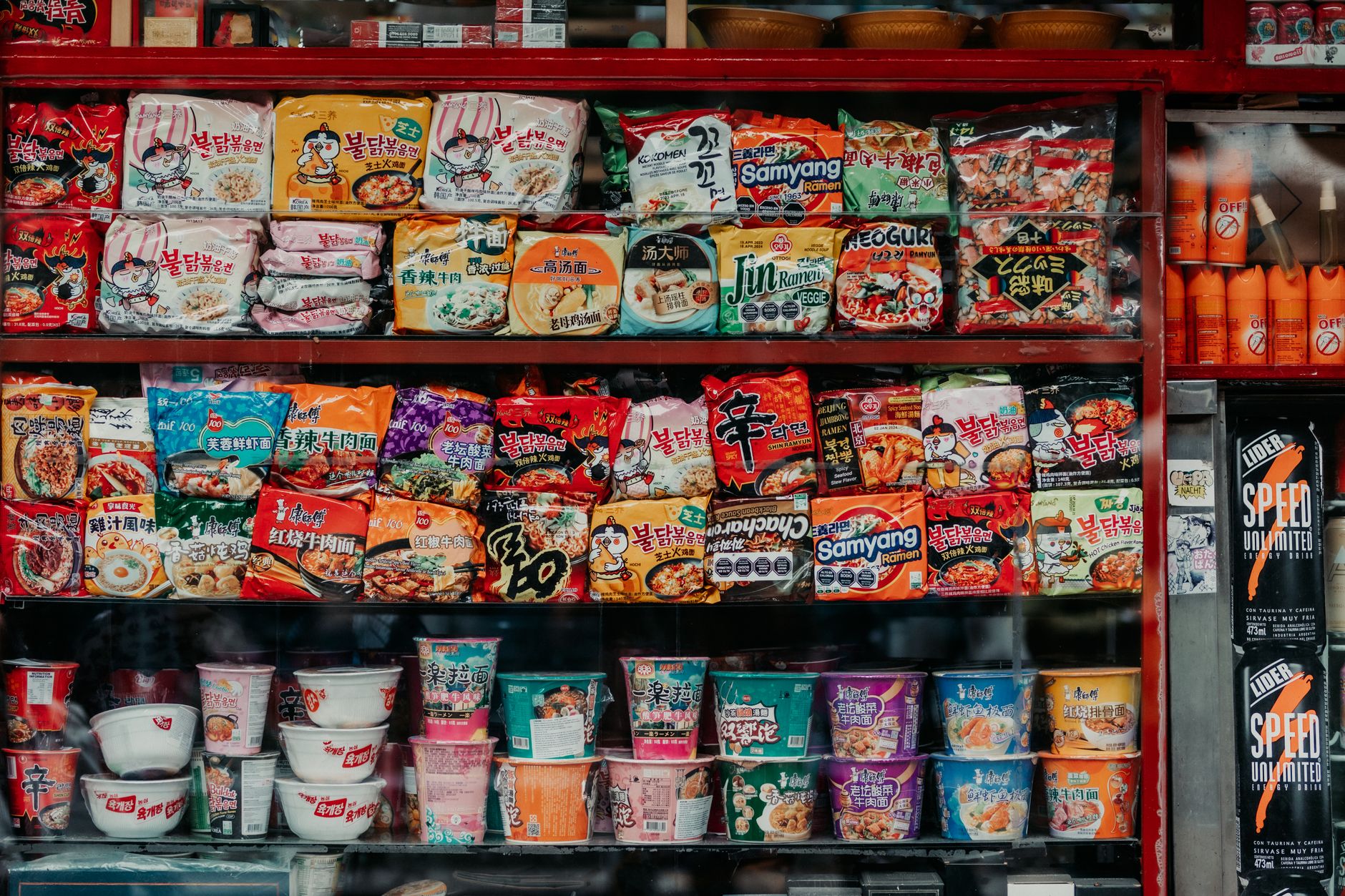
Shin Ramyun is the baseline Korean standard for spicy beef broth, Jin Ramen is the slightly milder everyday local favorite, Neoguri offers a thick-noodle seafood alternative, and Buldak is a fiery, brothless stir-fry built for extreme heat. Choose Buldak for a spice challenge, Neoguri for texture, and Shin or Jin for a traditional soup-based meal.
Market Position and Flavor Profiles
South Korea consumes over 4 billion servings of instant noodles annually, ranking second globally in per capita consumption. Four specific products dominate convenience store shelves, supermarket aisles, and export markets. They represent different flavor categories and textures.
Shin Ramyun (Nongshim) Launched in 1986, Shin Ramyun is the undisputed global face of Korean instant noodles. The flavor profile is built on a savory beef and mushroom broth, heavily seasoned with red chili pepper and garlic. The noodles are standard thickness and retain a firm chew if cooked correctly. It is a soup-based noodle designed to leave behind a rich broth, which locals traditionally finish by mixing in a scoop of white rice.
Jin Ramen Spicy (Ottogi) While Shin Ramyun dominates international exports, Jin Ramen frequently tops domestic consumption surveys as the noodle South Koreans buy most often for their home pantries. The spicy version of Jin Ramen features a slightly sweeter, smoother broth than Shin Ramyun, with a heavier emphasis on garlic and black pepper rather than sharp chili heat. It is also a standard-thickness, soup-based noodle.
Neoguri Spicy Seafood (Nongshim) Neoguri translates to "raccoon," a nod to the plump, round shape of its udon-style noodles. This product diverges from the standard beef base, utilizing a spicy seafood broth flavored with mussel, squid, and fish extracts. The defining characteristic of the Korean domestic version of Neoguri is the inclusion of a large, dried piece of kelp (kombu) in the packet, which steeps in the boiling water to create a deep umami base. The thicker noodles require a slightly longer boiling time.
Buldak Original (Samyang) Buldak Hot Chicken Flavor Ramen disrupted the market in 2012 by popularizing the extreme spice category. Unlike the other three, Buldak is a brothless stir-fry noodle (bokkeum-myeon). It features a liquid sauce packet rather than a powder base, delivering a sweet, smoky chicken flavor that is immediately followed by intense, lingering capsaicin heat. The noodles are slightly thicker and flatter than Shin Ramyun to better hold the sticky sauce.
Heat Levels and Cost Analysis
Spiciness in Korean instant noodles is measured in Scoville Heat Units (SHU). Manufacturers periodically adjust these formulas, but the current baseline figures provide a clear hierarchy of heat.
| Brand | Format | Scoville Rating (SHU) | Average Convenience Store Price |
|---|---|---|---|
| Jin Ramen (Spicy) | Soup | 3,000 SHU | ₩950 |
| Neoguri (Spicy) | Soup | ~2,500 SHU | ₩1,100 |
| Shin Ramyun (Original) | Soup | 3,400 SHU | ₩1,000 |
| Buldak (Original) | Stir-fry | 4,404 SHU | ₩1,300 |
Note: Prices reflect standard 120g-140g bag formats in Korean convenience stores (CU, GS25, 7-Eleven) as of late 2024 to 2026. Cup formats generally cost ₩200 to ₩300 more.
The numbers in the table do not tell the full story of how the heat is perceived. Buldak’s 4,404 SHU rating is only about 30% higher than Shin Ramyun’s 3,400 SHU. However, eating Buldak feels significantly hotter. In a soup-based noodle like Shin, the capsaicin is diluted across 550ml of water. In a brothless noodle like Buldak, the concentrated chili oil coats the noodles directly, ensuring the capsaicin sticks to the lips, tongue, and throat.
In South Korea, Shin Ramyun serves as the unofficial metric for spiciness. Waitstaff in restaurants will frequently answer questions about a dish's heat level by stating it is "spicier than Shin" or "about the same as Shin."
When purchasing, note the physical difference between bags and cups. A standard bag of Shin Ramyun contains 120g of noodles and requires a prolonged boil in a pot. A standard cup contains 75g of thinner noodles engineered to soften in three minutes using water from a convenience store dispenser.
Standard Cooking Procedures
Cooking Korean instant noodles requires precise water measurement. Eyeballing the water level usually results in a bland, diluted broth. Follow this action guide to prepare both soup-based and stir-fry formats correctly.
Step 1: Measure the water precisely For Shin Ramyun, Jin Ramen, and Neoguri, measure exactly 550ml of water into a pot. For Buldak, measure 600ml of water. Place the pot on high heat and bring it to a rolling boil.
Step 2: Add the ingredients For soup noodles (Shin, Jin, Neoguri), add the noodle block, the powder soup base, and the dehydrated vegetable packet into the boiling water simultaneously. For Neoguri, ensure the dried kelp piece goes in as well. For Buldak, add only the noodle block to the boiling water; keep the liquid sauce and garnish packets aside.
Step 3: Manage the cooking time Set a timer. Shin Ramyun and Jin Ramen require exactly 4 minutes and 30 seconds of boiling. Neoguri and Buldak require 5 minutes due to their thicker noodles. Use chopsticks to lift the noodles out of the water and expose them to the air a few times during the boil; this rapid cooling contracts the starch and results in a chewier texture.
Step 4: Drain and mix (Buldak only) If making Shin, Jin, or Neoguri, skip this step. If making Buldak, remove the pot from the heat after 5 minutes. Drain almost all the water, leaving exactly 8 tablespoons (about 120ml) in the pot. Add the liquid red sauce packet to the wet noodles. Return the pot to low heat and stir-fry for 30 seconds until the sauce thickens and coats the noodles.
Step 5: Garnish and serve Remove the pot from the heat. For Buldak, sprinkle the roasted sesame and seaweed garnish packet over the top. Serve immediately.
Convenience Store Upgrades
Korean convenience stores stock specific items meant to be mixed directly into instant noodles. If you are eating in a CU, GS25, or 7-Eleven, utilize these standard additions to upgrade the meal.
- Raw or Soft-Boiled Egg: For soup noodles, crack a raw egg into the boiling broth during the final 60 seconds of cooking. Do not stir it immediately, or the broth will become cloudy and lose its sharp spice. Let it poach.
- String Cheese: A highly recommended addition to Buldak. Tear a stick of mozzarella string cheese into strips, place it over the hot stir-fried noodles, and microwave the bowl for 30 seconds to melt the cheese and cut the intense heat.
- Samgak Kimbap (Triangle Rice Ball): Buy a tuna mayonnaise or jeonju bibimbap triangle rice ball. Once you finish the noodles of your Shin or Jin ramen, unwrap the rice ball, drop it directly into the leftover broth, and mash it with a spoon to create a thick, flavorful porridge.