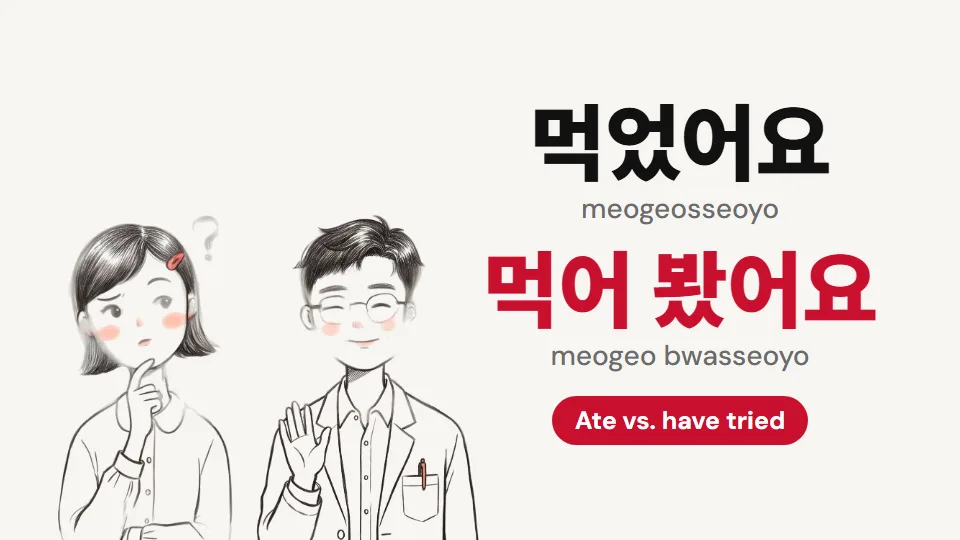
"Did you eat kimchi?" and "Have you ever tried kimchi?" are different questions, and Korean separates them with a small helper verb: -아/어 보다, "try" or "have done it at least once". One pattern covers "try this", "I've been there" and "I've never had that".
The rule
Take the verb stem, add 아 or 어 using the same vowel rule as the polite present (아요/어요), then add 보다 ("to see," used here as "to try").
- ㅏ or ㅗ in the last vowel: -아 보다
- other vowels: -어 보다
- 하다: 해 보다
| Verb | + 보다 | Meaning |
|---|---|---|
| 가다 (go) | 가 봐요 | I'll try going / go and see |
| 오다 (come) | 와 봐요 | come and see |
| 먹다 (eat) | 먹어 봐요 | try eating |
| 입다 (wear) | 입어 봐요 | try on |
| 하다 (do) | 해 봐요 | try doing |
| 마시다 (drink) | 마셔 봐요 | try drinking |
Both 먹어 보다 and 먹어보다 are acceptable. Spaced and unspaced versions are both standard, so you'll see either one.
Meaning 1: try it
The most common use is to invite or request a trial.
- 이거 한번 먹어 보세요. — Try this once.
- 이 길로 가 보세요. — Try going this way.
- 입어 봐도 돼요? — May I try this on?
- 한번 해 볼게요. — I'll give it a try.
한번 ("once") often accompanies it and makes it sound friendly: "give it a go."
Meaning 2: have done it before
To talk about life experience, use the form -아/어 본 적이 있다 (or 없다):
- 한국에 가 본 적이 있어요. — I've been to Korea.
- 불고기를 먹어 본 적이 있어요. — I've tried bulgogi.
- 스키를 타 본 적이 없어요. — I've never skied.
본 is the past modifier form of 보다, and 적 means "the occasion" or "the time." So 먹어 본 적이 있어요 is literally "there is an occasion of having tried eating."
For questions, the natural form is:
- 한국 음식을 먹어 본 적이 있어요? — Have you ever eaten Korean food?
- 김치 먹어 봤어요? — Have you tried kimchi?
The casual version, 먹어 봤어요? (the past of 먹어 보다), asks the same thing and is more common in conversation.
Past tense vs 아/어 보다
Compare these:
| Korean | What it says |
|---|---|
| 김치를 먹었어요. | I ate kimchi. (a fact about an event) |
| 김치를 먹어 봤어요. | I've tried kimchi. (an experience) |
The first answers "what did you do?" The second answers "have you ever done it?" Use 봤어요 when you're talking about whether you've had the experience at all, especially a first or occasional one.
Routine events don't take it. You wouldn't say 아침에 밥을 먹어 봤어요 for an ordinary breakfast.
Useful travel and food examples
- 서울에 처음 와 봤어요. — It's my first time coming to Seoul.
- 이거 먹어 봐도 돼요? — May I try this? (at a market or sample stall)
- 이 가게 가 본 적 있어요? — Have you been to this shop?
- 한번 입어 보고 살게요. — I'll try it on and then buy it.
- 한국에서 지하철 타 봤어요? — Have you taken the subway in Korea?
Notice 입어 보고 살게요: it combines the connecting ending -고 from the -고 and -(으)면서 guide with 아/어 보다.
Common mistakes
| ✗ | ✓ | Why |
|---|---|---|
| 어제 밥 먹어 봤어요 | 어제 밥 먹었어요 | Routine facts take the plain past. |
| 먹보다 | 먹어 보다 | Keep the 아/어. |
| 예뻐 봐요 | 예뻐 보여요 | "Looks pretty" is 보이다, not 보다. |
영화를 봤어요 ("I watched a movie") and 먹어 봤어요 ("I tried it") both contain 봤어요; the verb in front tells you which is which.