Korean food looks like it should be easy for vegetarians. Enormous quantities of vegetables, tofu in everything, rice at the center of every meal. In practice it's trickier than it appears, because the seasonings that make Korean food taste Korean are frequently seafood-based.
This isn't a reason to give up. It's a reason to know what to check.
The three hidden ingredients
Almost every surprise comes from one of these.
Fish sauce (aekjeot). Anchovy or sand lance based. Used in most kimchi, and in seasoning vegetable side dishes. It's the number one reason a plate of seasoned spinach isn't vegetarian.
Salted shrimp (saeujeot). A cloudy, intensely salty shrimp paste. Standard in kimchi, and used to season some soups and steamed dishes.
Anchovy stock (myeolchi yuksu). The default broth base for a huge number of Korean soups and stews, including many that contain no visible meat or fish. Doenjang jjigae is usually built on it. So is the broth in most noodle dishes.

The pattern is worth internalizing: Korean food hides seafood in the background rather than the foreground. A dish can be entirely vegetables and still be seasoned with fish.
Is kimchi vegan?
Usually not. Traditional kimchi contains fish sauce, salted shrimp, or both.
However:
- Temple kimchi (sachal kimchi) is made without any animal products, and also without garlic and onion, following Korean Buddhist practice.
- Commercial vegan kimchi is now widely available and labeled as such. Read the ingredients rather than assuming.
- Making it yourself is straightforward — replace the fish sauce with soy sauce or a doenjang slurry, and the salted shrimp with a bit more salt. The result ferments the same way and tastes close.
White kimchi (baek kimchi) is not automatically vegan either, despite having no chili. Check the same way.
Dishes that are genuinely vegetarian
These don't typically hide seafood, though it's still worth asking at a restaurant.
- Bibimbap without egg or beef — ask for it without gochujang if you're strict, since some brands contain small amounts of seafood extract, though most don't.
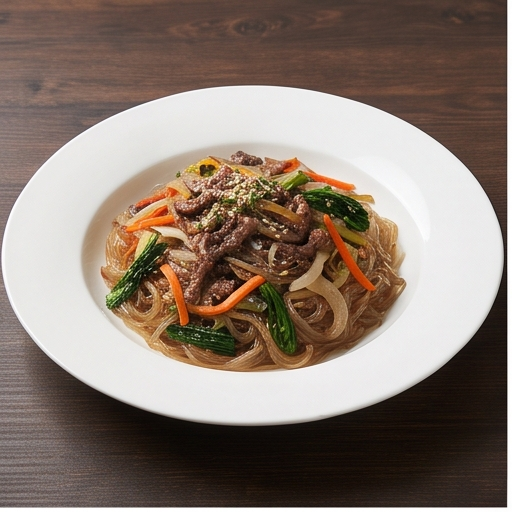
- Japchae — the base is sweet potato noodles, soy sauce, sesame oil, and vegetables. Commonly made without meat.
- Gyeranjjim — steamed egg, if eggs are acceptable to you.
- Kongguksu — cold noodles in chilled soybean broth. Genuinely vegan.
- Pajeon or kimchijeon made at home — the batter is flour and water; only the fillings vary.
- Namul — seasoned vegetable dishes, when made with soy sauce and sesame oil rather than fish sauce.
Building a vegetarian Korean pantry
The one substitution that unlocks most recipes is the stock.
Replace anchovy stock with dried shiitake and kelp simmered together — this is the standard Korean Buddhist temple base, not an improvised workaround. It has real depth and works anywhere anchovy stock is called for.
Beyond that:
- Soy sauce in place of fish sauce, roughly one to one, with a little extra salt
- Doenjang for savory weight — check the label, but most is soybean only
- Gochujang — most brands are vegetarian; a few contain seafood extract, so read once and stick to that brand
- Dried shiitake stems and caps, kept in the cupboard
With those, doenjang jjigae, sundubu jjigae, noodle soups, and most vegetable banchan all become available.
What to ask at a restaurant
Saying "I don't eat meat" often isn't enough, since fish sauce and anchovy stock aren't thought of as meat. The more useful question is whether the dish contains fish sauce, shrimp paste, or anchovy broth specifically.
Writing it down in Korean before you go helps considerably.
Cooking vegetarian Korean food at home? K-Pantry shows you which dishes work with the ingredients you already have, and what to swap in when something's missing.