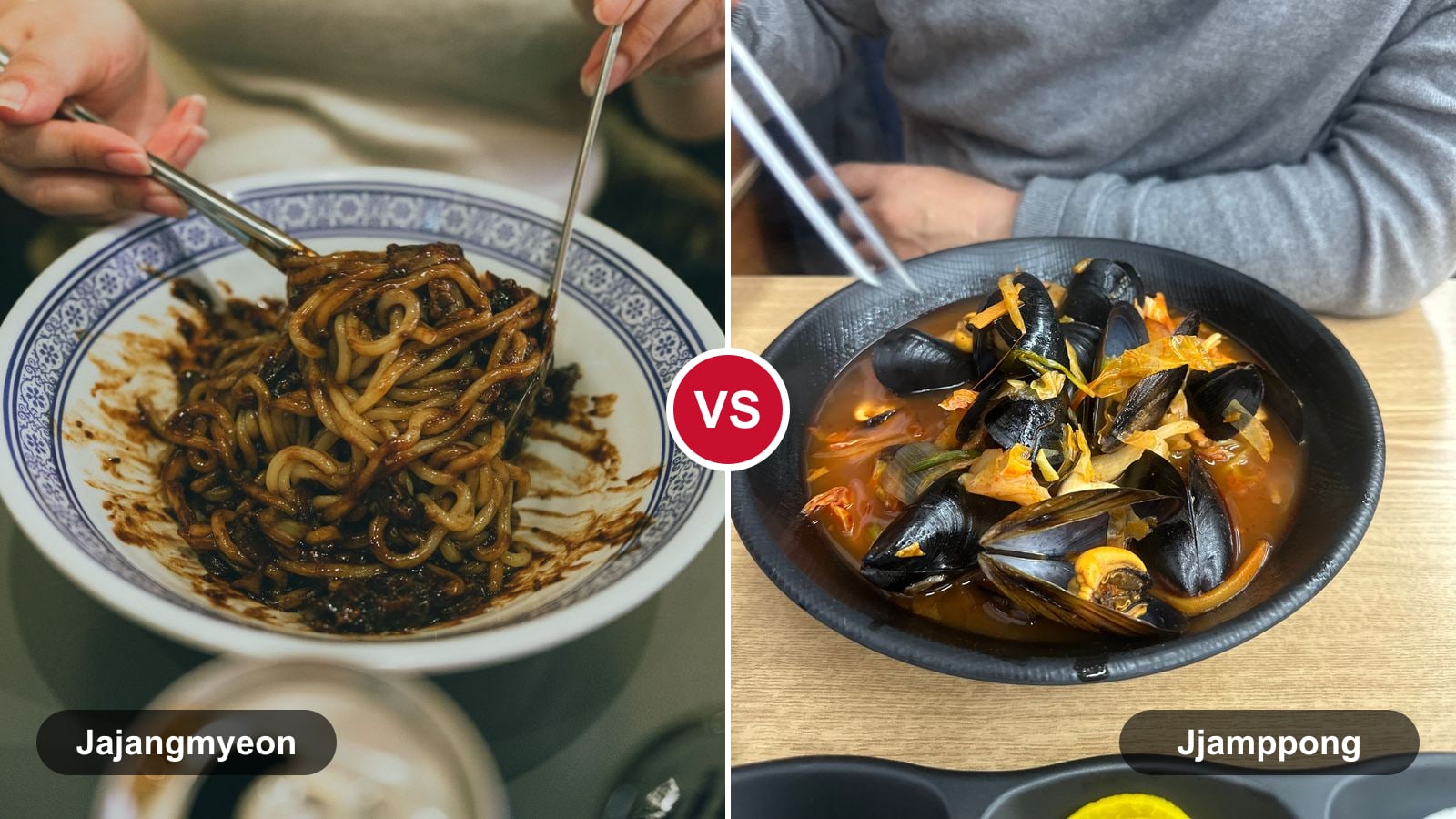
Jajangmyeon (sweet, savory black bean noodles) and Jjamppong (spicy, smoky seafood noodle soup) form the ultimate culinary rivalry in Korea's everyday dining scene. Choosing between them depends entirely on whether you crave a rich, comforting, sauce-coated noodle or a fiery, sweat-inducing broth packed with seafood.
This guide breaks down the flavor profiles, variations, cultural etiquette, and ordering strategies for these two legendary dishes so you can navigate any Korean-Chinese restaurant with confidence.
Flavor Profiles, Ingredients, and Key Differences
To the uninitiated, entering a Korean-Chinese restaurant (Junghwa Yori / 중화요리) can be daunting. The menu is dominated by these two giant noodle dishes, both of which utilize thick, chewy, hand-pulled wheat noodles but take them in completely opposite directions.
Jajangmyeon (짜장면): The Comfort Classic
Jajangmyeon is a dish of thick wheat noodles topped with a warm, glossy, dark-brown sauce made from chunjang (춘장), a salty black bean paste fermented with wheat flour and caramel color. The paste is fried in lard or vegetable oil alongside diced pork, onions, cabbage, and sometimes zucchini or potatoes.
The resulting flavor is deeply savory, slightly sweet, and rich. It is not spicy at all, making it the default comfort food for children and adults alike.
Within the Jajangmyeon family, you will encounter several common variations:
- Gan-jajang (간짜장): The sauce is stir-fried dry without water or starch thickeners and served in a separate bowl from the noodles. It has a more intense, smoky, and less sweet flavor, with the onions retaining a crisp texture.
- Uni-jajang (유니짜장): All ingredients, including the pork and vegetables, are finely minced. This creates a smooth, uniform sauce that clings tightly to every noodle strand.
- Samseon-jajang (삼선짜장): A premium version that incorporates three types of fresh seafood—typically squid, shrimp, and sea cucumber.
Jjamppong (짬뽕): The Fiery Seafood Feast
Jjamppong is a spicy, red, broth-based noodle soup. The broth is built by flash-frying garlic, ginger, green onions, and red pepper flakes (gochugaru / 고춧가루) in a blazing hot wok to create a distinct smoky aroma known as bul-mat (불맛), or "fire flavor."
This spicy base is then simmered with a mountain of ingredients: sliced pork, cabbage, onions, wood ear mushrooms, and an array of seafood such as squid, mussels, clams, and baby octopus. The flavor is intensely savory, spicy, and oceanic, with a subtle sweetness from the cooked cabbage.
Common Jjamppong variations include:
- Samseon-jjamppong (삼선짬뽕): Features a higher quality and quantity of seafood, often including whole small octopuses, crab pieces, or larger prawns.
- Gogi-jjamppong (고기짬뽕): Focuses heavily on pork strips rather than seafood, resulting in a thicker, heavier, and creamier broth.
- Baek-jjamppong (백짬뽕): A white, non-spicy version of the soup. It retains the deep seafood and garlic flavors but omits the red pepper flakes, making it ideal for those who cannot tolerate high spice levels.
| Feature | Jajangmyeon (짜장면) | Jjamppong (짬뽕) |
|---|---|---|
| Primary Flavor | Sweet, savory, earthy, rich | Spicy, smoky, garlicky, oceanic |
| Main Sauce/Broth | Thick, stir-fried black bean paste (chunjang) | Fiery, red pepper-infused seafood broth |
| Key Proteins | Diced pork | Squid, mussels, clams, sliced pork |
| Spice Level | Non-spicy | Medium to very spicy |
| Average Cost | Approx. 6,000 to 9,000 KRW | Approx. 8,000 to 12,000 KRW |
The Ultimate Compromise and Essential Side Dishes
The rivalry between these two dishes is so intense that it birthed a modern culinary invention: Jjamjamyon (짬짜면). This is a single bowl physically divided down the middle, containing a half-portion of Jajangmyeon on one side and a half-portion of Jjamppong on the other. If you cannot decide, look for this option on the menu.
Tangsuyuk: The Mandatory Companion
No Korean-Chinese meal is complete without sharing a plate of Tangsuyuk (탕수육), which is crispy, deep-fried pork strips coated in a sweet and sour translucent sauce made with vinegar, sugar, carrots, wood ear mushrooms, and onions.
When Tangsuyuk is served, you will witness one of Korea's most lighthearted but passionate culinary debates:
- Bumeok (부먹): Pouring the sweet sauce directly over the fried pork so the batter absorbs the liquid and becomes soft and chewy.
- Jjikmeok (찍먹): Dipping the dry, crispy pork pieces into the sauce bowl individually to preserve the maximum crunch.
Local Etiquette Tip: If you are sharing a plate of Tangsuyuk with locals, never pour the sauce over the meat without asking first. Many Koreans are fiercely defensive of the jjikmeok (dipping) method. The safest approach is to dip, or ask: "Bumeok-alkkayo, jjikmeok-alkkayo?" (부먹할까요, 찍먹할까요? - "Should we pour or dip?").
Complimentary Table Sides
Every Korean-Chinese restaurant will automatically serve two complimentary side dishes:
- Danmuji (단무지): Yellow, pickled radish slices. Their sweet, acidic crunch is essential for cutting through the rich grease of Jajangmyeon or cooling down the heat of Jjamppong.
- Raw Onions and Chunjang: Raw onion chunks served with a small dollop of raw black bean paste. Dip the onion into the paste for a sharp, sweet, and pungent bite.
Dining Etiquette and Local Eating Hacks
To enjoy these dishes like a local, you should adopt a few practical dining habits.
- Wear the Apron: Jajangmyeon sauce is notorious for splattering, and Jjamppong broth will leave permanent red stains on light clothing. Look around the restaurant walls for hanging black or red aprons (apchima / 앞치마), or ask the staff: "Apchima juseyo" (앞치마 주세요 - "Please give me an apron").
- The Two-Handed Mix: When your Jajangmyeon arrives, do not simply stir it gently. Take a metal chopstick in each hand, insert them into the center of the noodle mound, and pull outward and upward. Repeat this lifting and folding motion until every noodle is completely coated in glossy black sauce.
- The Gochugaru Trick: If you find Jajangmyeon slightly too sweet or heavy after a few bites, locate the small spice shaker of red pepper powder (gochugaru) on your table. Sprinkle a generous dusting over the black sauce. This cuts the sweetness and adds a subtle, pleasant warmth.
- The Vinegar Hack for Radishes: Locals often grab the vinegar bottle (sikcho / 식초) on the table and splash a few drops directly over the yellow pickled radishes (danmuji) to enhance their sourness and crisp texture.
- Shell Disposal: Jjamppong comes loaded with whole mussels and clams. Before you start eating the noodles, use your chopsticks to pry the meat from the shells, dropping the empty shells into the small metal bowl (kkeopdegi geureut / 껍데기 그릇) provided on the table. This prevents your noodles from getting cold while you struggle with shells mid-meal.
Step-by-Step Guide to Ordering Like a Local
Whether you are dining at a neighborhood restaurant or ordering delivery (baedal / 배달) to your hotel or apartment, follow these steps to secure your meal.
Step 1: Identify the Right Restaurant
Look for signs containing the words 중화요리 (Junghwa Yori - Chinese Cuisine), 관 (Gwan), 각 (Gak), or 반점 (Banjeom). These suffixes almost always indicate a classic Korean-Chinese noodle house.
Step 2: Choose Your Order and Use Key Phrases
If you are dining with a partner, the most common local strategy is to order one Jajangmyeon, one Jjamppong, and a small Tangsuyuk to share. This is often sold as a pre-packaged discount set on the menu, labeled as 세트 메뉴 (Set Menu).
Use these phrases to order:
- "Jajangmyeon hana, jjamppong hana juseyo." (짜장면 하나, 짬뽕 하나 주세요.) "One Jajangmyeon and one Jjamppong, please."
- "Tangsuyuk soteuro juseyo." (탕수육 소짜로 주세요.) "Please give me a small-sized Tangsuyuk."
- "Danmuji deo juseyo." (단무지 더 주세요.) "Please give me more pickled radish."
Step 3: Mix, Eat, and Pay
If dining in, you will usually pay at the counter near the exit after finishing your meal. Walk up to the counter and say:
- "Kadeuro gyeolje-halgeyo." (카드로 결제할게요.) "I will pay by card."
If you ordered delivery via an app like Baemin (Baedal Minjeok) or Yogiyo, the food may arrive in reusable plastic bowls inside a blue or red plastic delivery box. If the restaurant uses real reusable dishes (less common now but still active in older neighborhoods), do not throw them away. Once you finish eating, place the dirty dishes back into the blue plastic bag provided, tie it up, and leave it outside your apartment door. The delivery rider will return later to collect them. If they arrive in disposable containers, simply rinse and dispose of them in your standard recycling bins.