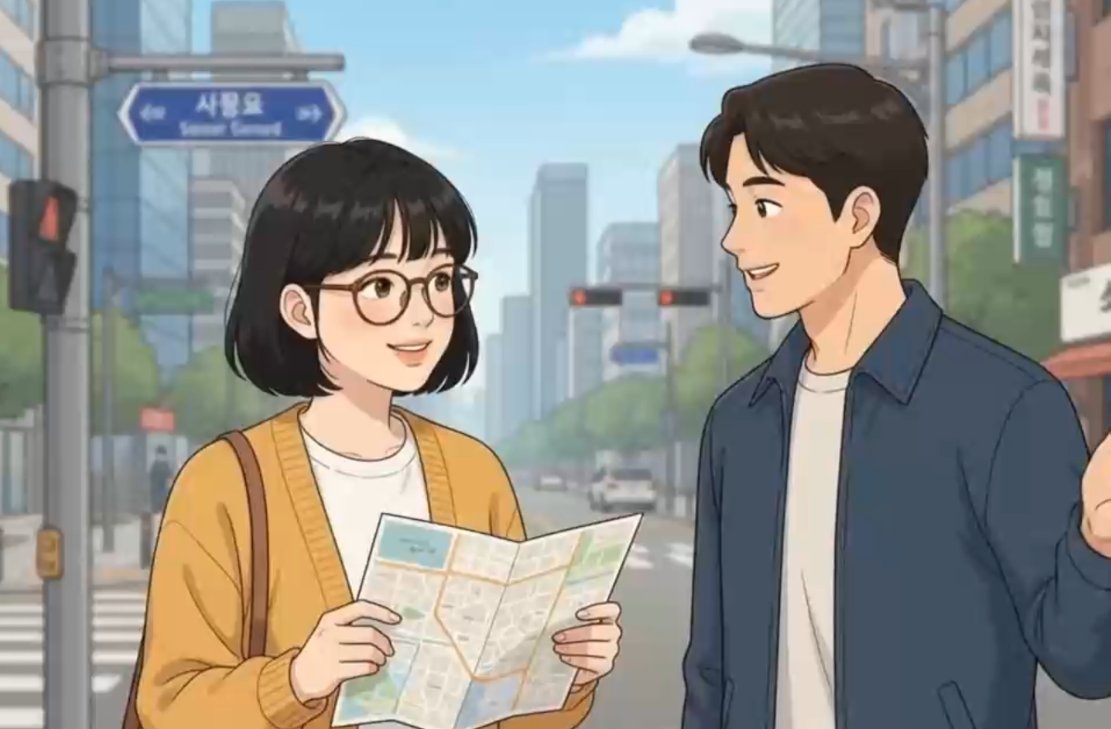
Asking for directions in a new language has an obvious trap: you ask a perfect question and then cannot follow the answer.
So the useful preparation is not the question. It is the four or five reply patterns that cover almost every set of Korean directions you will be given.
Getting attention
저기요 — the standard way to address a stranger. Say it clearly and slightly loudly. It is not rude.
실례합니다 is more formal and works too, though 저기요 is far more common on the street.
The question
~에 어떻게 가요? — How do I get to ~?
- 경복궁에 어떻게 가요?
- 지하철역에 어떻게 가요?
- 화장실 어디예요? — Where's the bathroom?
If you are lost rather than navigating:
- 길을 잃었어요. — I'm lost.
- 여기가 어디예요? — Where am I?
Saying 길을 잃었어요 first changes the answer you get — people slow down and often walk you part of the way.
The four replies you will actually hear
1. Keep going straight
- 쭉 가세요. — Go straight.
- 이 길로 쭉 가면 돼요. — Just go straight along this road.
쭉 means "straight on, continuously." It appears in almost every set of directions.
2. Turn
- 왼쪽으로 가세요. — Go left.
- 오른쪽으로 꺾으세요. — Turn right.
- 저기 끝에서 왼쪽으로 꺾으면 돼요. — Turn left at the end there.
꺾다 is "to turn a corner" and is more common in spoken directions than 돌다.
3. Landmarks
- 편의점 지나서 — past the convenience store
- 신호등에서 — at the traffic light
- 사거리에서 — at the intersection
- 건너편에 있어요. — It's on the other side.
Koreans give directions by landmark far more than by distance. Convenience stores are the most common reference point because there is always one.
4. It's close / far
- 바로 저기예요. — It's right there.
- 걸어서 오 분이요. — Five minutes on foot.
- 좀 멀어요. 버스 타세요. — It's a bit far. Take the bus.
Direction words
| Korean | Meaning |
|---|---|
| 왼쪽 | left |
| 오른쪽 | right |
| 직진 | straight ahead |
| 앞 | in front |
| 뒤 | behind |
| 옆 | next to |
| 건너편 | opposite side |
| 사거리 | four-way intersection |
| 횡단보도 | crosswalk |
When you did not catch it
These matter more than the question itself.
- 다시 한번 말해 주세요. — Please say that again.
- 천천히 말해 주세요. — Please speak slowly.
- 잘 못 알아들었어요. — I didn't quite catch that.
못 알아들었어요 is the honest one and Koreans respond to it well — usually by slowing down and pointing.
A real exchange
You: 저기요, 길을 잃었어요. 경복궁에 어떻게 가요? Passerby: 이 길로 쭉 가면 돼요. 저기 끝에서 왼쪽으로 꺾으면 돼요. You: 감사합니다!
Two sentences from them, and both use patterns from the list above.
See it happen
Episode 14 of K-PATTO is exactly this scene — Emma gets lost, asks a stranger, and understands the answer well enough to find her way. The reply she gets uses 쭉 and 꺾다, which is what makes it realistic rather than textbook.
Read it at K-PATTO.