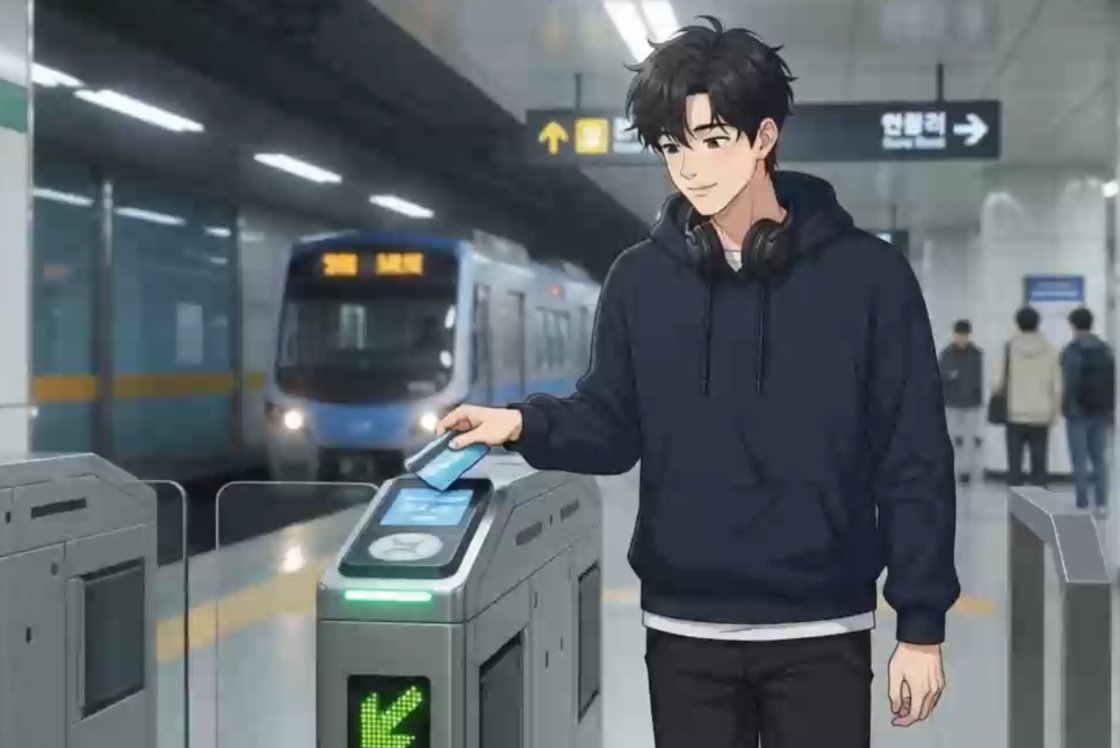
Seoul's subway is one of the easiest systems in the world to use without speaking the language. Everything is colour-coded, signs are in English, and apps handle the routing.
Which means most visitors never say a word in it — right up until the moment something goes wrong and they need to ask.
Asking how to get somewhere
~에 어떻게 가요? — how do I get to ~?
- 경복궁에 어떻게 가요? — How do I get to Gyeongbokgung?
- 홍대입구에 어떻게 가요? — How do I get to Hongdae?
This is the single most useful sentence for getting around. Add 저기요 in front to get someone's attention first.
어디서 타요? — where do I get on?
여기서 갈아타요? — do I transfer here?
The answer you will get
Most answers use one of two patterns, so recognising them matters more than producing them.
~으로 갈아타세요 — transfer to ~
- 여기서 3호선으로 갈아타세요. — Transfer to Line 3 here.
~에서 내리세요 — get off at ~
- 시청역에서 내리세요. — Get off at City Hall.
If you catch the line number and the station name, you have enough. You do not need the rest of the sentence.
Words on the signs
| Korean | Meaning |
|---|---|
| 환승 | transfer |
| 방면 | in the direction of |
| 출구 | exit |
| 급행 | express |
| 일반 | local (all stops) |
| 상행 / 하행 | inbound / outbound |
| 교통카드 | transit card |
방면 is the one that saves you. Platform signs say 왕십리 방면 — toward Wangsimni — which tells you which direction the train goes, and that is usually the thing you got wrong.
출구 matters more than you expect. Large stations have fifteen exits spread over several blocks, and taking the wrong one means a long walk. Exit numbers are the standard way Koreans give directions: 3번 출구에서 만나요 — let's meet at Exit 3.
What the announcements say
The same few sentences repeat at every station.
- 이번 역은 ○○역입니다. — This station is ○○.
- 내리실 문은 왼쪽입니다. — The doors open on the left.
- 다음 역은 ○○역입니다. — The next station is ○○.
- 안전선 밖으로 물러서 주십시오. — Please stand back from the safety line.
These are in the formal -습니다 style used in public announcements. You will never need to say them, but recognising 이번 역 and 다음 역 lets you stop staring at the map.
Topping up your card
At a convenience store or a station machine:
- 충전해 주세요. — Please charge it.
- 만 원 충전해 주세요. — Charge 10,000 won.
- 카드 주세요. — (buying one) A card, please.
T-money cards work on subways, buses, and many taxis, and you can buy one at any convenience store.
When you are genuinely lost
- 길을 잃었어요. — I'm lost.
- 여기가 어디예요? — Where am I?
- 이 역 맞아요? — Is this the right station?
Koreans are unusually willing to help with directions, often walking you to the right platform. 저기요 to get attention, then the question.
See it happen
Episode 2 of K-PATTO takes place in a subway station. Emma is lost in a crowd and has to ask:
저기요, 경복궁에 가고 싶어요. 어떻게 가요? — Excuse me, I want to go to Gyeongbokgung. How do I get there? 여기서 3호선으로 갈아타세요. — Transfer to Line 3 here.
Every line has audio at natural speed, which is the part that matters here — station announcements and quick directions are fast. The first ten episodes are free at K-PATTO.