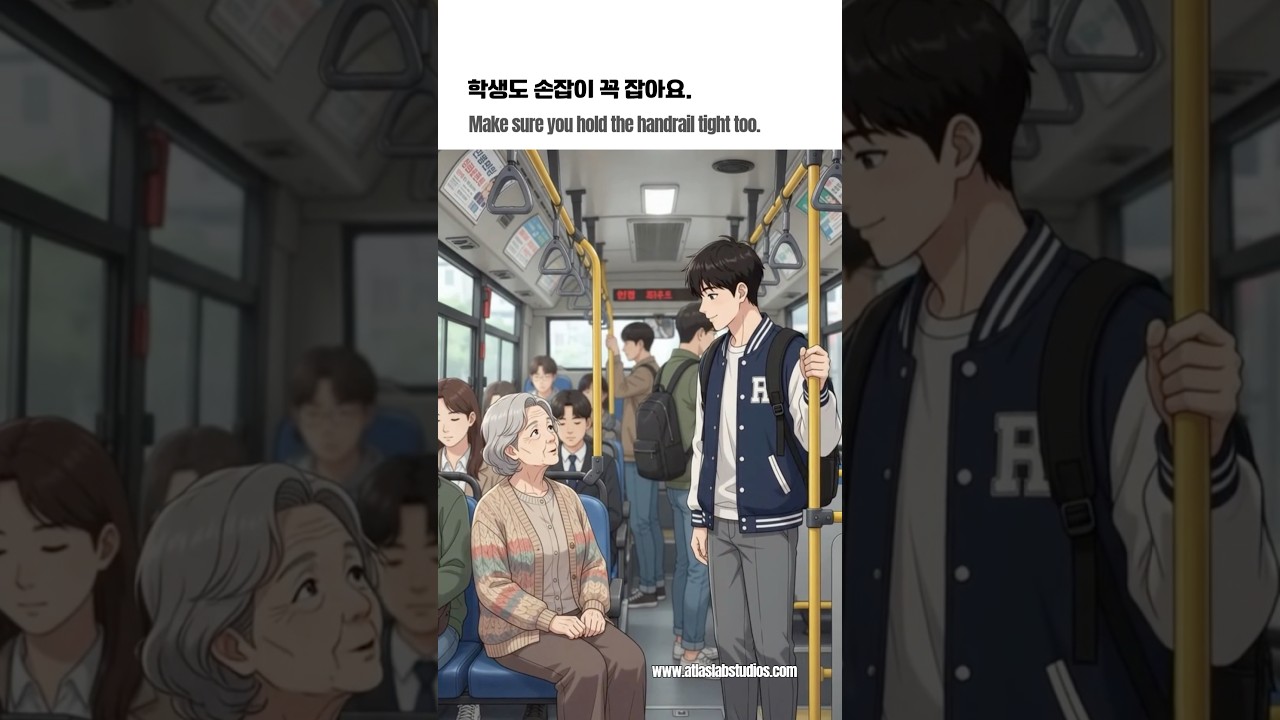
You're sitting. An elderly person boards. You catch their eye.
What happens next is one of the most Korean moments you'll see on public transport.
The exchange
어르신, 여기 앉으세요! eo-reu-sin, yeo-gi an-ju-se-yo! "Ma'am / Sir, please have a seat here!"
어르신 is the respectful term for elderly people — more formal than 할머니 (grandmother) or 할아버지 (grandfather), and appropriate for a stranger. Use it whenever you want to address an older person politely.
어머, 학생 고마워요. eo-meo, hak-saeng go-ma-wo-yo. "Oh, thank you, young man."
어머 is a soft exclamation of surprise — like "oh my" or "oh!" It's used almost exclusively by women, particularly older women. When you hear it, something caught them off guard in a pleasant way.
학생 literally means "student," but older Koreans use it to address any young person, the way you might say "young man" or "young lady" in English. It's warm, not condescending.
아니에요, 편하게 앉아서 가세요. a-ni-e-yo, pyeon-ha-ge an-ja-seo ga-se-yo. "Not at all, please sit comfortably."
아니에요 here isn't "no" — it's the Korean way of saying "don't mention it" or "it's nothing." Always say this after someone thanks you for a kind gesture.
학생도 손잡이 꼭 잡아요. hak-saeng-do son-ja-bi kkok ja-pa-yo. "Make sure you hold the handrail tight too."
She thanks you, and then she looks after you. That's the elder-younger dynamic in Korea — it runs in both directions.
Words to know
| Korean | Romanization | Meaning |
|---|---|---|
| 어르신 | eo-reu-sin | Elderly person (respectful) |
| 어머 | eo-meo | Oh! (surprised exclamation) |
| 학생 | hak-saeng | Student; young person (address) |
| 아니에요 | a-ni-e-yo | Not at all, don't mention it |
| 편하게 | pyeon-ha-ge | Comfortably |
| 손잡이 | son-ja-bi | Handrail, handle |
Seat etiquette on Seoul public transport
Seoul buses and subway cars have designated priority seats — marked in a different color, usually pink or purple, near the doors. These are for elderly passengers, pregnant women, people with disabilities, and those with young children.
Even on regular seats, giving up your seat when an older person is standing is expected. You don't have to announce it — just stand up, gesture toward the seat, and say 어르신, 여기 앉으세요.
Most people do this naturally. If you do it, you'll get a reaction like this one: a surprised 어머, a warm thank-you, and possibly some unsolicited life advice for the rest of the ride.
Responding to thanks
When someone thanks you for a small kindness in Korea, don't say nothing. Say:
아니에요 — "Not at all" 별말씀을요 (byeol-mal-sseum-eu-ryo) — "It was nothing" (more formal) 괜찮아요 — "It's fine, no problem"
Silence after a thank-you reads as cold. One of these three phrases closes the exchange warmly.
What to actually do
- When an elderly person boards and there are no seats, stand up
- Gesture to your seat and say 어르신, 여기 앉으세요
- When they thank you, say 아니에요, 편하게 앉아서 가세요
- Grab the handrail — buses stop fast
One phrase, one gesture — and you've done something that matters to the person on the other end of it.
Korean public transport etiquette is built on small acts of consideration. K-PATTO teaches 300+ phrases like these through a webtoon story set in Seoul, with native audio on every line. The first ten episodes are free.