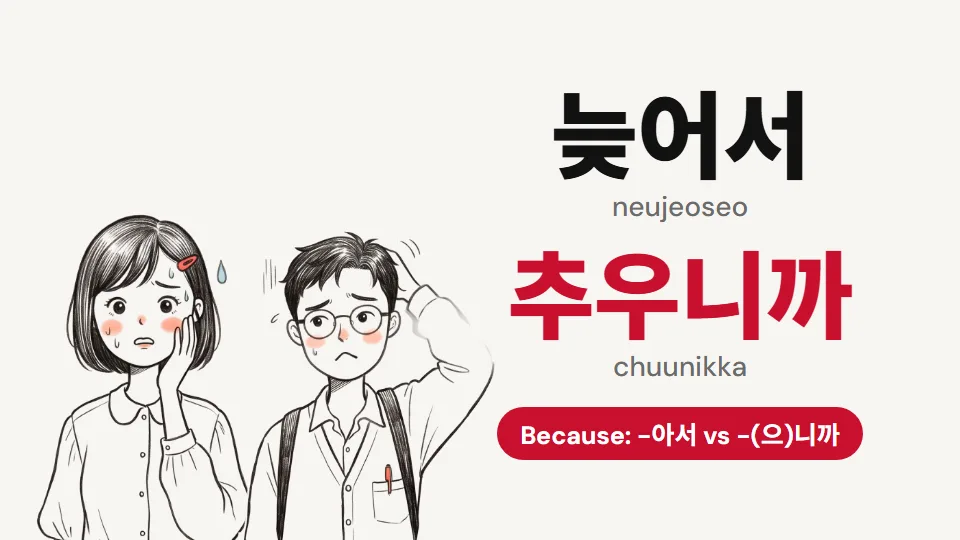
Korean has two everyday ways to say "because": -아/어서 and -(으)니까. Textbooks often translate both as "because, so", but they don't swap. The difference shows up in the most ordinary sentences: an apology, a suggestion, a reason to leave early.
The short version: -아서 explains a cause. -(으)니까 gives your reason, usually for what comes next.
How to build them
-아/어서 follows the same vowel rule as 아요/어요: take the polite form, drop 요, add 서. -(으)니까 is -니까 after a vowel and -으니까 after a consonant; a final ㄹ drops.
| Verb | -아/어서 · -(으)니까 | Note |
|---|---|---|
| 늦다 (be late) | 늦어서 · 늦으니까 | regular |
| 바쁘다 (be busy) | 바빠서 · 바쁘니까 | ㅡ drops before 아 |
| 피곤하다 (be tired) | 피곤해서 · 피곤하니까 | 하다 → 해서 |
| 춥다 (be cold) | 추워서 · 추우니까 | ㅂ irregular |
| 멀다 (be far) | 멀어서 · 머니까 | ㄹ drops before 니까 |
| 없다 (not have) | 없어서 · 없으니까 | consonant → 으니까 |
Rule 1: requests and suggestions take -(으)니까
If the second half is a request, an order, a suggestion or "let's", only -(으)니까 works.
| ✗ | ✓ | Meaning |
|---|---|---|
| 비가 와서 우산 가져가세요. | 비가 오니까 우산 가져가세요. | It's raining, so take an umbrella. |
| 배고파서 밥 먹을까요? | 배고프니까 밥 먹을까요? | I'm hungry, so shall we eat? |
| 멀어서 택시 타자. | 머니까 택시 타자. | It's far, so let's take a taxi. |
| 피곤해서 쉬세요. | 피곤하니까 쉬세요. | You're tired, so get some rest. |
The same first halves are fine with -아서 when the second half just states a fact: 비가 와서 집에 있었어요 (biga waseo jibe isseosseoyo, "it rained, so I stayed home").
Rule 2: no past tense before -아서
-아서 never takes 았/었, even for a past cause. The final verb carries the tense.
| ✗ | ✓ | Meaning |
|---|---|---|
| 늦었어서 죄송해요. | 늦어서 죄송해요. | Sorry I was late. |
| 비가 왔어서 못 갔어요. | 비가 와서 못 갔어요. | It rained, so I couldn't go. |
-(으)니까 does take tense: 어제 많이 먹었으니까 오늘은 조금만 먹을게요 (eoje mani meogeosseunikka oneureun jogeumman meogeulgeyo, "I ate a lot yesterday, so I'll eat light today").
Rule 3: -(으)니까 sounds like your own reasoning
-(으)니까 presents the reason as the speaker's judgment, so in a plain answer it can sound pointed.
| Answer to 왜 안 왔어요? | Romanization | How it sounds |
|---|---|---|
| 바빠서요. | bappaseoyo | "I was busy." Neutral, explaining. |
| 바빴으니까요. | bappasseunikkayo | "Because I was busy, obviously." Can sound defensive. |
When you're simply explaining, -아서 is the safer default.
Rule 4: -(으)니까 can mean "when I did…, I found…"
With a past action, -(으)니까 also means you discovered something:
- 가 보니까 문이 닫혀 있었어요. (ga bonikka muni dachyeo isseosseoyo) When I went, the door was closed.
- 먹어 보니까 맛있었어요. (meogeo bonikka masisseosseoyo) When I tried it, it was good.
This pairs with -아/어 보다 all the time.
Common mistakes
| ✗ | ✓ | Why |
|---|---|---|
| 피곤해서 쉬세요. | 피곤하니까 쉬세요. | A request needs -(으)니까. |
| 먹었어서 | 먹어서 | No past tense before -아서. |
| 늦었으니까 죄송해요. | 늦어서 죄송해요. | Apologies use -아서. |
| 멀으니까, 살으니까 | 머니까, 사니까 | ㄹ drops before 니까. |