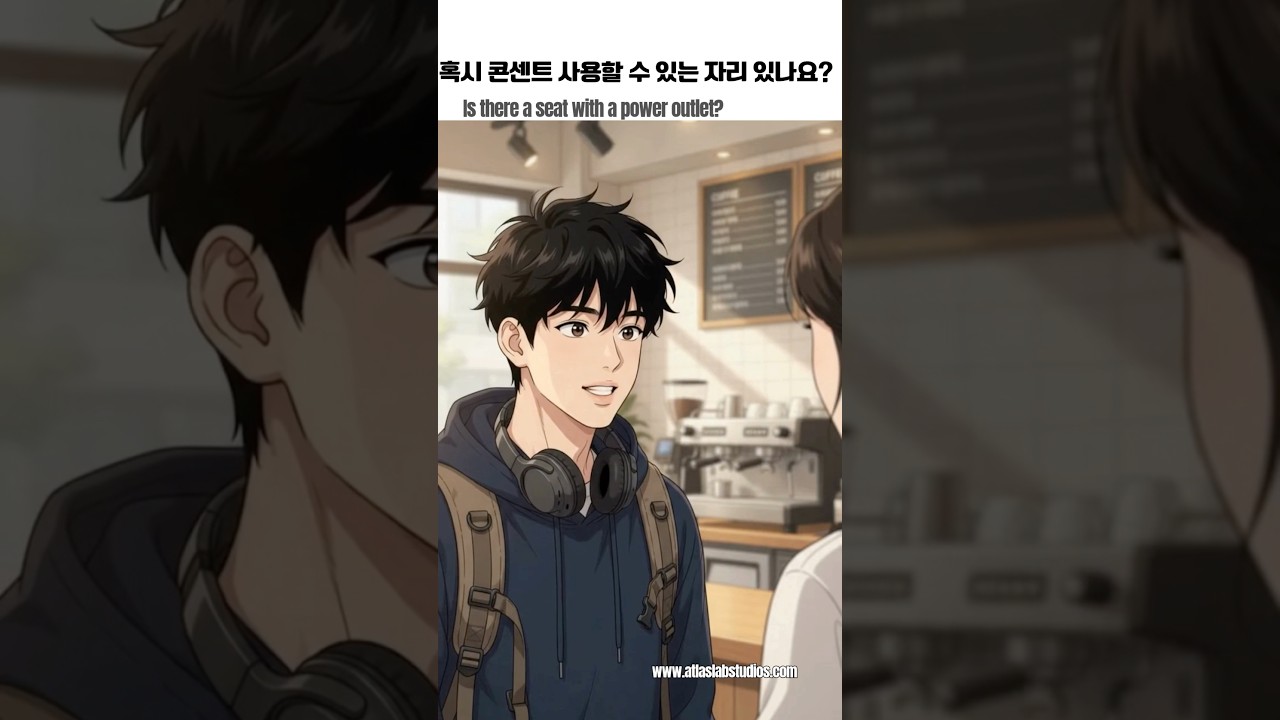
Korean cafes are designed for staying. People work there for entire afternoons, students study through the night at 24-hour branches, and nobody hovers over your table wondering when you'll leave.
Two questions get you set up.
Asking for a seat with an outlet
혹시 콘센트 사용할 수 있는 자리 있나요? hok-si kon-sen-teu sa-yong-hal su it-neun ja-ri it-na-yo? "Is there a seat with a power outlet?"
That's the full polite version. Shorter forms work just as well:
| Korean | Romanization | Meaning |
|---|---|---|
| 콘센트 있어요? | kon-sen-teu iss-eo-yo? | Is there an outlet? |
| 자리 있어요? | ja-ri iss-eo-yo? | Are there seats available? |
| 콘센트 자리 있어요? | kon-sen-teu ja-ri iss-eo-yo? | A seat with an outlet? |
콘센트 is the Korean word for a power outlet, borrowed from the English "concentric plug." It won't sound familiar, but it's the only word used.
Expect an answer like 안쪽에 있어요 (an-jjok-e iss-eo-yo) — "in the back." Outlet seats are usually along walls.
Asking for the wifi password
와이파이 비번 알 수 있을까요? wa-i-pa-i bi-beon al su iss-eul-kka-yo? "Could I get the wifi password?"
비번 is the everyday shortening of 비밀번호 (bi-mil-beon-ho, password). Both are fine; 비번 is what people actually say.
Common answers:
- 저기 적혀 있어요 — jeo-gi jeok-hyeo iss-eo-yo — "It's written over there"
- 영수증에 있어요 — yeong-su-jeung-e iss-eo-yo — "It's on the receipt"
- 대문자예요 — dae-mun-ja-ye-yo — "It's uppercase"
That last one matters more than it sounds. Korean cafe passwords are often case-sensitive strings printed in small type, and getting the capitals wrong is the most common reason it won't connect.
You usually won't need to ask
Most Korean cafes post the wifi password on a small sign at the counter, on the wall, or printed at the bottom of your receipt. Look before asking.
Many chains also use open networks with no password at all, or a simple one like the store's phone number.
How long you can stay
Longer than you'd expect. Sitting in a cafe for three or four hours with a laptop is completely normal, and staff won't approach you.
A few chains post time limits during peak hours — usually a sign saying 2시간 (two hours) — but they're rarely enforced.
If you're staying a while, ordering a second drink after a few hours is a small courtesy rather than a requirement.
Cafes built for working
Korea has a whole category of cafe designed around this. 스터디카페 (study cafe) are paid-by-the-hour spaces with individual desks and outlets at every seat. They're not cafes in the drink sense — you pay for the seat, and drinks are usually self-serve from a machine.
Regular cafes near universities often have the same setup with wall outlets at most tables.
What to actually do
- Order first, then look for a seat
- Ask 콘센트 자리 있어요? if you need power
- Check the counter and your receipt for the wifi password before asking
- If you ask, listen for 대문자 — the capitals matter
- Stay as long as you like
Cafes are one of the easiest places to spend time in Korea, and these two questions cover almost everything you'll need at the counter.
Short practical exchanges like these are what daily life in Korea actually sounds like. K-PATTO teaches 300+ phrases through a webtoon story set in Seoul, with native audio on every line. The first ten episodes are free.