Korean won't put a number straight next to a noun. It adds a small word for the kind of thing you're counting: cups, bottles, people, tickets. These are counters, and you need one almost every time you order, buy or book something. Ten of them cover nearly every trip.
The noun can drop when it's obvious: pointing at a pastry and saying 세 개 주세요 ("three, please") is completely natural.
Why 하나 becomes 한
Most counters take native Korean numbers, and five of them shorten before a counter.
| On its own | Before a counter | Example |
|---|---|---|
| 하나 (1) | 한 | 한 개 |
| 둘 (2) | 두 | 두 잔 |
| 셋 (3) | 세 | 세 명 |
| 넷 (4) | 네 | 네 병 |
| 스물 (20) | 스무 | 스무 개 |
The rest stay the same: 다섯 개, 여섯 명, 열 잔. In combined numbers only the last part changes: 열한 개 (11), 스물두 명 (22).
The ten counters for a trip
| Counter | Used for | Example |
|---|---|---|
| 개 (gae) | things in general | 사과 두 개: two apples |
| 명 (myeong) | people | 학생 세 명: three students |
| 분 (bun) | people, politely | 두 분: two people |
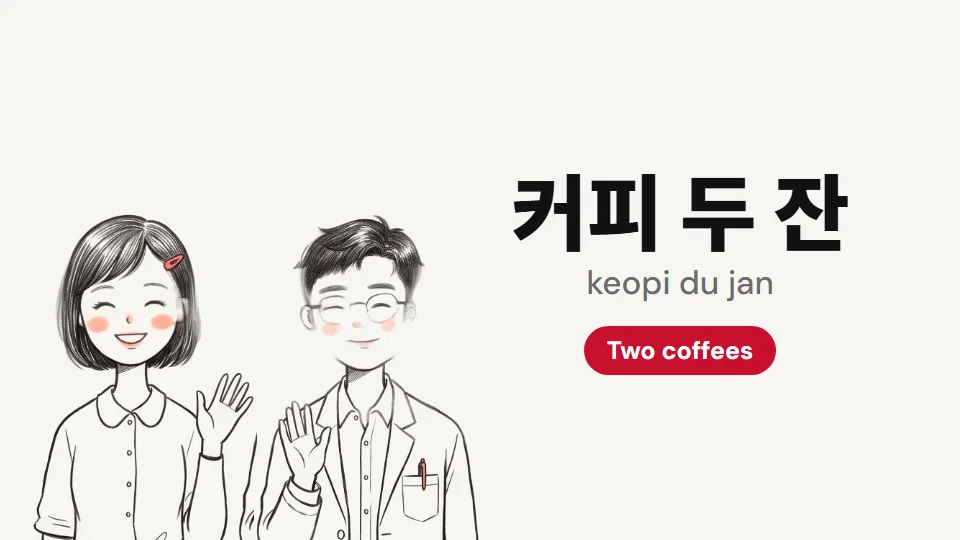
| 잔 (jan) | cups, glasses | 커피 한 잔: a cup of coffee |
| 병 (byeong) | bottles | 물 두 병: two bottles of water |
| 그릇 (geureut) | bowls | 밥 한 그릇: a bowl of rice |
| 마리 (mari) | animals, whole chicken or fish | 치킨 한 마리: a whole fried chicken |
| 장 (jang) | flat things: tickets, paper | 표 두 장: two tickets |
| 대 (dae) | cars, machines | 택시 한 대: one taxi |
| 인분 (inbun) | servings of a dish | 삼겹살 2인분: two servings of pork belly |
개 is the safety net. If you forget the right counter for an object, 개 works for most small things. It never works for people: use 명.
인분 is the odd one out: it takes Sino-Korean numbers. 2인분 is read 이인분 (iinbun), and barbecue usually has a two-serving minimum.
Native or Sino-Korean?
The counter decides which number system you use. This is where most learners slip.
| Counting | Numbers | Example |
|---|---|---|
| 개, 명, 잔… | native | 커피 두 잔 keopi du jan |
| hours (시) | native | 세 시 se si |
| age (살) | native | 스무 살 seumu sal |
| minutes (분) | Sino-Korean | 삼십 분 samsip bun |
| money (원) | Sino-Korean | 오천 원 ocheon won |
| servings (인분) | Sino-Korean | 이인분 iinbun |
| floors, dates | Sino-Korean | 삼 층 sam cheung, 오월 오일 owol oil |
Watch the two 분s: 두 분 (native) is "two people", 이 분 (Sino-Korean) is "two minutes". The guide to Korea's two number systems covers the rest.
What you'll hear
| You'll hear | Meaning | Answer |
|---|---|---|
| 몇 분이세요? | How many in your party? | 두 명이요. |
| 몇 개 드릴까요? | How many shall I give you? | 세 개 주세요. |
| 몇 인분 드릴까요? | How many servings? | 2인분 주세요. |
| 몇 잔 드릴까요? | How many cups? | 두 잔이요. |
| 병으로 드릴까요? | By the bottle? | 네, 병으로 주세요. |
Staff use 분 about you; you use 명 about your own group. 몇 (myeot, "how many") takes the number's place and keeps the counter. Before 명 it's pronounced myeon: 몇 명이에요? sounds like myeon myeongieyo.
Common mistakes
| ✗ | ✓ | Why |
|---|---|---|
| 삼 명, 이 개 | 세 명, 두 개 | These counters take native numbers. |
| 두 인분 | 2인분 (이인분) | 인분 takes Sino-Korean numbers. |
| 사람 두 개 | 두 명 | People take 명 (or 분). |