Korean has no month names to memorize: January is "month one", February "month two", and so on. Dates work the same way, and a full date runs from big to small: year, month, day. There are only two traps, and they're the two months everyone gets wrong at first.
The months
Every month is a Sino-Korean number + 월 (wol, "month").
| Month | Korean | Romanization |
|---|---|---|
| January | 일월 | irwol |
| February | 이월 | iwol |
| March | 삼월 | samwol |
| April | 사월 | sawol |
| May | 오월 | owol |
| June | 유월 | yuwol |
| July | 칠월 | chirwol |
| August | 팔월 | parwol |
| September | 구월 | guwol |
| October | 시월 | siwol |
| November | 십일월 | sibirwol |
| December | 십이월 | sibiwol |
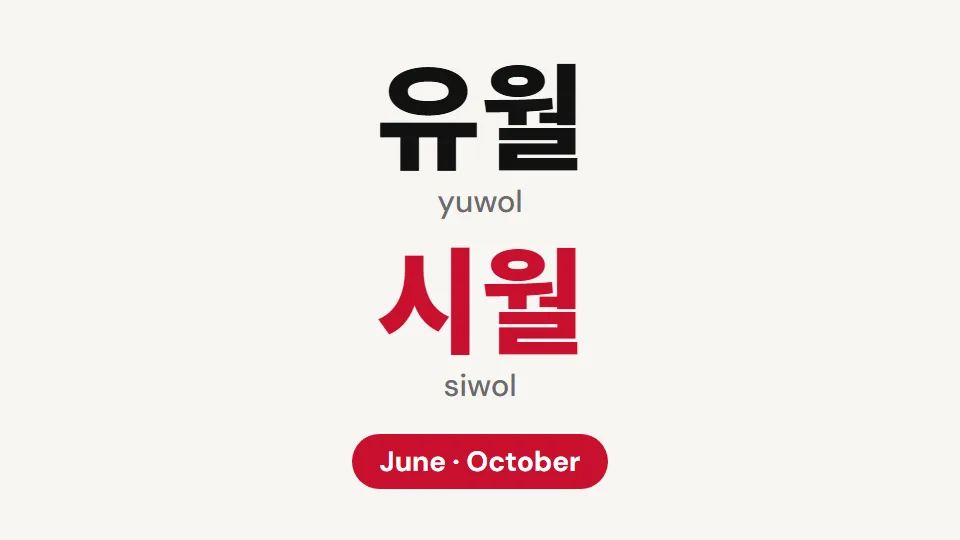
June and October drop a final consonant to make them easier to say: 육 → 유, 십 → 시. You'll see them written 6월 and 10월 with digits, but they're always read 유월 and 시월.
Dates and the full date
Dates are a Sino-Korean number + 일 (il, "day"): 일일 (1st), 이일 (2nd), 십오일 (15th), 삼십일일 (31st).
A full date goes from big to small, the opposite of American order:
| Written | Said | Meaning |
|---|---|---|
| 2026년 11월 4일 | 이천이십육 년 십일월 사 일 | November 4, 2026 |
| 3월 1일 | 삼월 일 일 | March 1 |
| 12월 25일 | 십이월 이십오 일 | December 25 |
Asking the date uses 며칠 ("which day of the month"). It's spelled 며칠, not 몇일, even though it comes from 몇 ("how many").
- 오늘 며칠이에요? — What's the date today?
- 생일이 몇 월 며칠이에요? — When's your birthday? (literally "what month, what day")
The days of the week
Every day ends in 요일 (yoil). Learn the first syllable and you have the day.
| Day | Korean | First syllable means |
|---|---|---|
| Monday | 월요일 woryoil | moon (월) |
| Tuesday | 화요일 hwayoil | fire (화) |
| Wednesday | 수요일 suyoil | water (수) |
| Thursday | 목요일 mogyoil | wood (목) |
| Friday | 금요일 geumyoil | metal (금) |
| Saturday | 토요일 toyoil | earth (토) |
| Sunday | 일요일 iryoil | sun (일) |
In casual speech and on signs, the single syllable is often enough: 월 · 화 · 수 · 목 · 금 · 토 · 일. Opening hours like 월–금 10:00–19:00 use exactly that.
Booking in Korean
A booking sentence stacks the date, the weekday and the time, big to small, then the verb. Hours use native numbers (here's why), so 7 p.m. is 저녁 일곱 시.
- 11월 15일 토요일 저녁 일곱 시에 예약하고 싶어요. — I'd like to book for Saturday, November 15, at 7 p.m.
- 다음 주 금요일 두 명이요. — Two people, next Friday.
- 며칠까지 계세요? — Until what date are you staying? (a hotel question)
- 월요일에 쉬어요? — Are you closed on Mondays?
Many small restaurants close one weekday, often Monday, and post it as 매주 월요일 휴무 ("closed every Monday").
Common mistakes
| ✗ | ✓ | Why |
|---|---|---|
| 육월, 십월 | 유월, 시월 | The two irregular months. |
| 4일 11월 | 11월 4일 | Big to small: month, then day. |
| 넷 일, 열다섯 일 | 사일, 십오일 | Dates use Sino-Korean numbers. |
| 몇일 | 며칠 | The standard spelling. |
The hour is the one part of a booking that uses native numbers: 일곱 시 (7 o'clock). The two number systems guide explains the split.