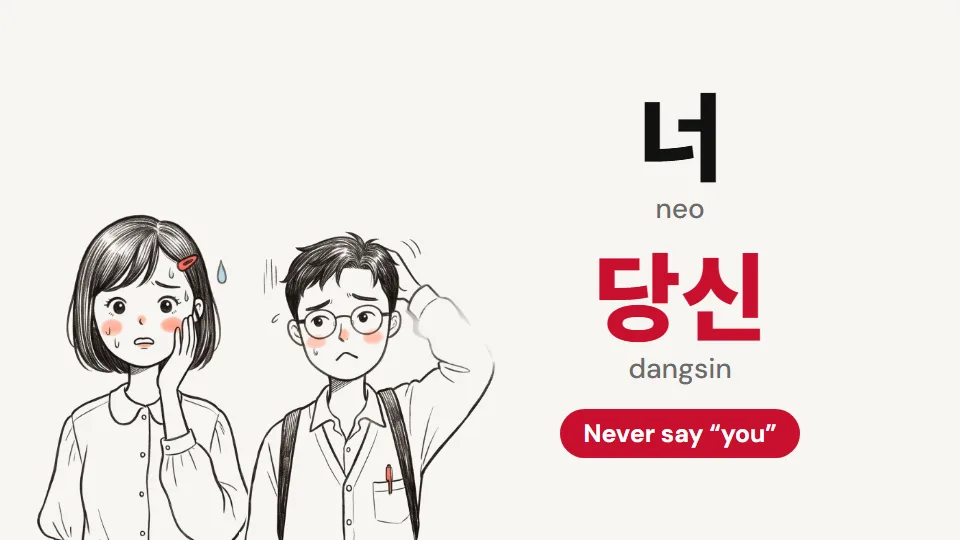
In English, "you" works for a king or a toddler. Korean has two words that look like "you", 너 and 당신, and the safest thing to do with both is to leave them out.
Why 너 and 당신 are risky
너 is the casual "you." It's the form you use with close friends your own age, or with someone younger. Said to anyone else, it sounds disrespectful.
당신 looks like the polite version, and that's the trap. In daily speech it's not polite at all.
- Between strangers, 당신 sounds confrontational, like "hey, you."
- Between spouses, especially older couples, it can be affectionate or serious.
- In songs, dramas, and advertising slogans, it appears all the time (당신의 하루, "your day").
So you'll see 당신 everywhere, and you shouldn't say it to a stranger. Think of it as a word to recognize, not to use.
The real solution: drop "you" completely
Korean doesn't need the word. When the listener is obvious, you simply leave it out.
| English | Korean | Notes |
|---|---|---|
| Do you want some coffee? | 커피 마실래요? | no "you" |
| Where are you going? | 어디 가세요? | -세요 shows respect |
| Have you eaten? | 식사하셨어요? | -셨 shows respect |
| Are you a student? | 학생이세요? | -세요 again |
The respect comes from the verb ending. Adding -(으)시- to a verb raises the person you're talking about, and since you're talking to them, that's the "polite you." (See the politeness levels guide for how the endings fit together.)
What to say instead
When you do need to address someone, use a title or a name with a suffix.
| Situation | Say | Romanization |
|---|---|---|
| Shop or restaurant owner | 사장님 | sajangnim |
| Teacher, or a respected professional | 선생님 | seonsaengnim |
| Boss or senior colleague | title + 님 (팀장님) | timjangnim |
| Customer (said by staff) | 고객님 / 손님 | gogaengnim / sonnim |
| Peer or stranger at a similar level | name + 씨 (민수 씨) | minsu ssi |
| Older male friend (said by a man) | 형 | hyeong |
| Older female friend (said by a woman) | 언니 | eonni |
| Getting a stranger's attention | 저기요 | jeogiyo |
A few notes on this table.
- 사장님 is how you address almost any shop or restaurant owner. It works even when the person is just staff, and it's never wrong.
- 저기요 means "Excuse me." It's the most useful word of all, because it gets someone's attention with no name needed.
- 씨 goes after a full name or a given name (민수 씨, 김민수 씨). Don't use it with someone senior to you, and avoid a bare surname plus 씨 (김 씨), which can sound curt.
- In casual restaurants, many customers call a female server 이모 ("aunt"). It's friendly, but follow what the people around you do.
When 너 is okay
너 is fine with:
- close friends of the same age, once you've agreed to speak casually
- children and people younger than you in casual situations
The rule that keeps you safe: if you're not sure, don't. Use a name, a title, or just drop the word.
A few more situations
At a restaurant. Say 저기요 to call a server, then 이거 주세요 ("This one, please"). You never need "you."
At a hotel or shop. Staff will call you 고객님 or 손님. You call them 사장님, or simply start with 저기요.
With a new friend. Ask 이름이 뭐예요? ("What's your name?") and then use their name plus 씨 until they tell you to relax.
In a taxi. Say 기사님, which means "driver, sir." It's polite and expected.
Common mistakes
| ✗ | ✓ | Why |
|---|---|---|
| 당신은 누구예요? | 누구세요? | 당신 sounds like a challenge. |
| 너 (to be friendly) | name + 씨 | 너 reads as rude, even meant kindly. |
| (to a boss) 민수 씨 | 팀장님, 사장님 | 씨 is for peers and juniors. |
If leaving "you" out feels strange, that's usually a sign you're doing it right: most Korean sentences drop the subject.