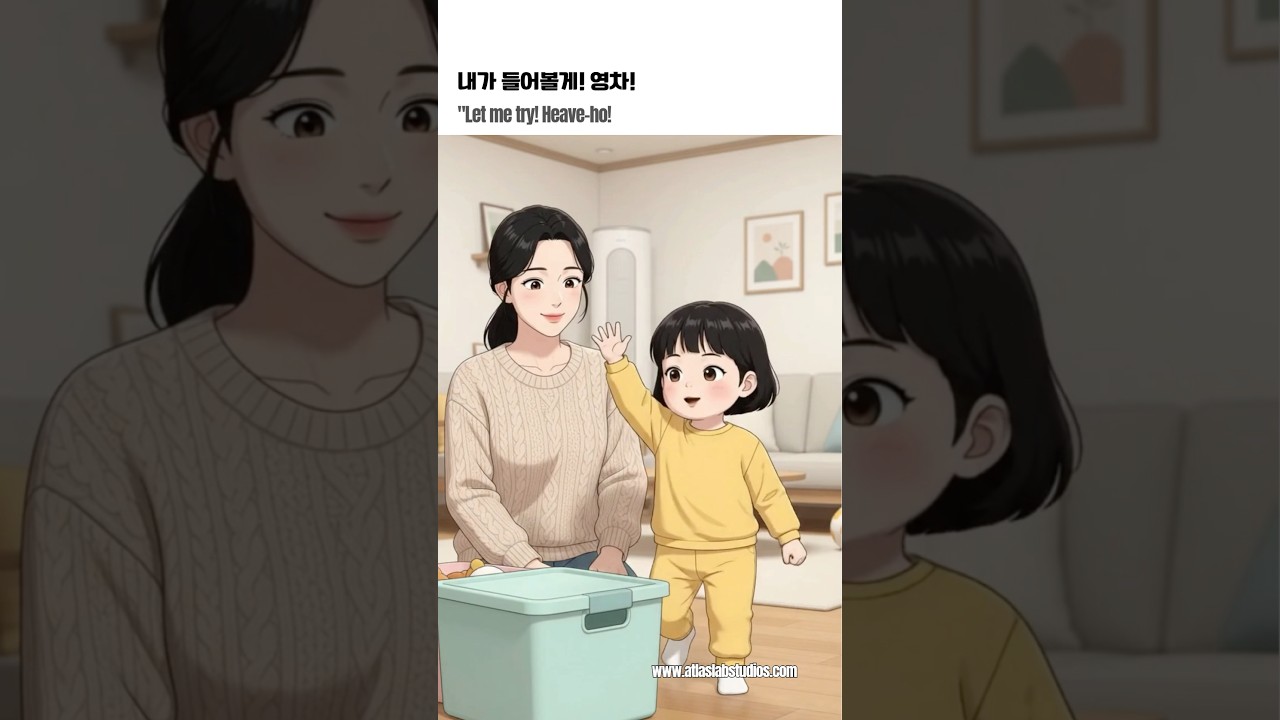
A heavy box, a parent who can't lift it, and a child who wants to try. The scene is the same anywhere. The Korean around it shows two things worth knowing: how families talk to each other, and how that changes when you offer help to an adult.
The exchange
A: 와, 상자가 너무 무겁네! 엄마는 못 들겠어!
(Wow, this box is so heavy! Mommy can't lift it!)
B: 내가 들어볼게! 영차!
(Let me try! Heave-ho!)
A: 번쩍 들었네! 와, 우리 아기 힘세다!
(You lifted it right up! Wow, you are so strong, sweetie!)
Every line here is casual speech (반말), which is normal between a parent and a young child. Said to an adult you don't know well, the same words would sound rude. The polite versions are further down.
Why "엄마는", not "I"
Korean parents talk about themselves in the third person when speaking to their children: 엄마는 못 들겠어 is literally "Mom can't lift it." Dads do the same with 아빠. It sounds warm, not strange, and you'll hear it in every playground.
Other adults use the same words for parents: a neighbor might call a mother 민준이 엄마 ("Minjun's mom") rather than by her own name.
Words in the exchange
| Korean | Romanization | Meaning |
|---|---|---|
| 무겁네! | mugeomne! | It's heavy! (a surprised reaction) |
| 못 들겠어 | mot deulgesseo | I can't lift it |
| 들어볼게 | deureobolge | I'll try lifting it |
| 영차! | yeongcha! | Heave-ho! (also 으쌰!) |
| 번쩍 | beonjjeok | in one quick motion |
| 우리 아기 | uri agi | sweetie, literally "our baby" |
| 힘세다! | himseda! | You're strong! |
-네 marks a reaction to something you've just noticed: 무겁네, 들었네. 못 ~겠어 means "I can't (manage to) ~": swap the verb for 못 먹겠어 (I can't eat it), 못 걷겠어 (I can't walk anymore).
우리 아기 suits toddlers. With an older child, parents use the name plus 이 after a consonant: 우리 민준이 힘세다!
Polite or casual?
| Casual (family, children) | Polite (adults, strangers) | Meaning |
|---|---|---|
| 무겁네! | 무겁네요! | It's heavy! |
| 못 들겠어. | 못 들겠어요. | I can't lift it. |
| 내가 들어볼게. | 제가 들어 볼게요. | Let me try lifting it. |
| 힘세다! | 힘이 세시네요! | You're strong! |
Note 내가 → 제가: the polite "I" is humbler, not just longer.
Offering help to an adult
This is the version you're most likely to need on a trip: someone older struggling with a suitcase, a box, or bags on the subway stairs.
| Korean | Romanization | Meaning |
|---|---|---|
| 도와드릴까요? | dowadeurilkkayo? | Shall I help you? |
| 제가 들어 드릴게요. | jega deureo deurilgeyo | Let me carry it for you. |
| 같이 들어요. | gachi deureoyo | Let's lift it together. |
| 하나, 둘, 셋! | hana, dul, set! | One, two, three! |
| 조심하세요. | josimhaseyo | Careful. |
들어 볼게요 means "I'll try lifting it." 들어 드릴게요 means "I'll lift it for you", and the 드리다 makes it a respectful offer. For helping older people on public transport, see giving up your seat on a Seoul bus.
Praise for children
| Korean | Romanization | Meaning |
|---|---|---|
| 잘했어! | jalhaesseo! | Well done! |
| 최고야! | choegoya! | You're the best! |
| 대단하다! | daedanhada! | That's amazing! |
| 역시! | yeoksi! | I knew you could! |
All four are casual, for children and close friends only.
What to actually say
- Something is heavier than you expected: 와, 무겁네요!
- Offering help to an adult: 제가 들어 드릴게요.
- Lifting together: 같이 들어요. 하나, 둘, 셋!
- Praising a child: 우리 [이름] 힘세다!