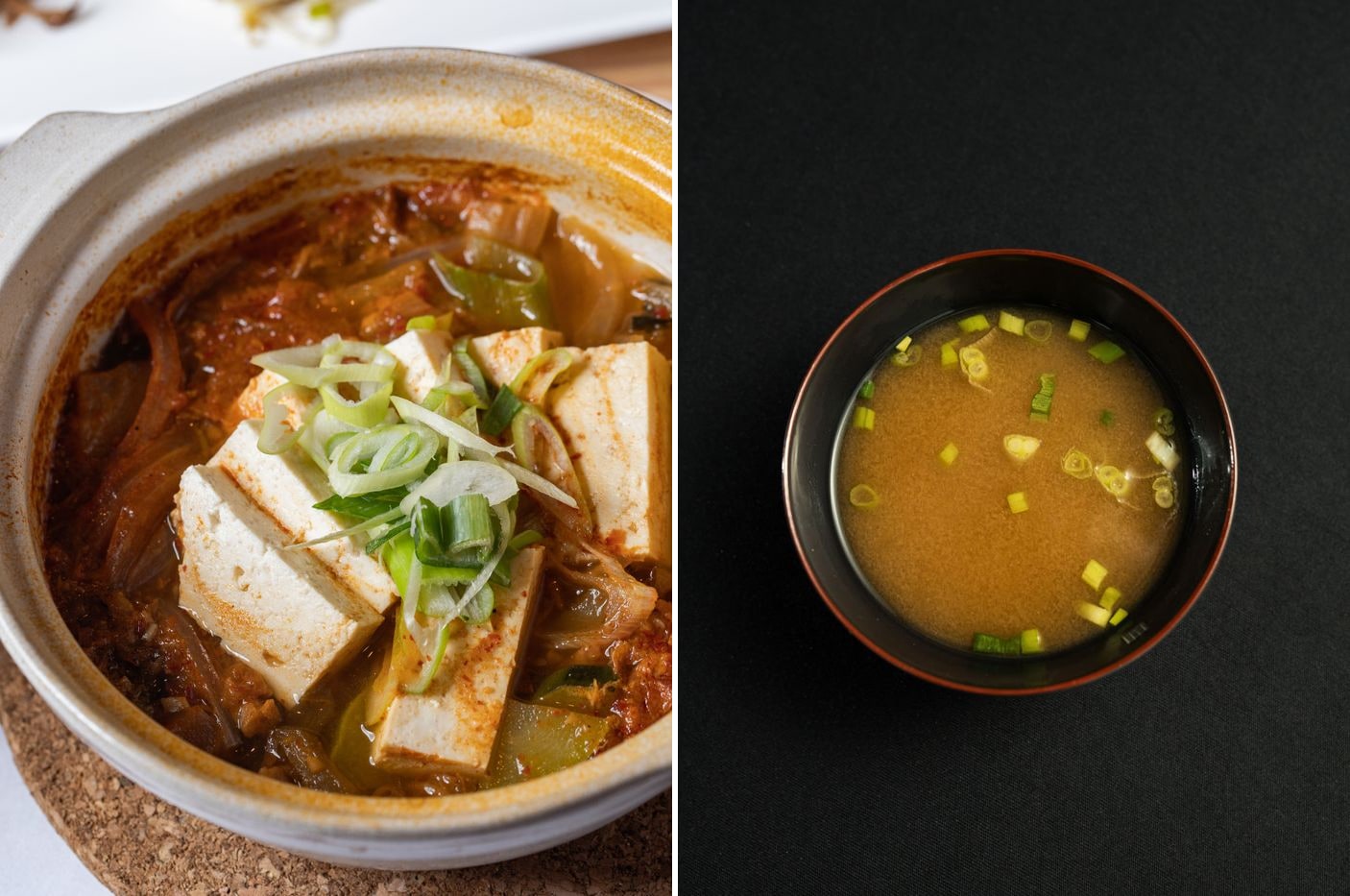
You can substitute miso for doenjang in Korean stews, but you must adjust the quantity, cooking time, and flavor profile. Because doenjang is saltier, funkier, and designed for long boiling, replacing it requires using red or awase miso, adding a small amount of soy sauce, and stirring the paste in at the very end of the cooking process to preserve its delicate flavor.
Core Differences in Fermentation and Flavor
Doenjang (Korean fermented soybean paste) and miso (Japanese fermented soybean paste) share a basic biochemical foundation but diverge entirely in their ingredients and fermentation processes. This creates two distinct flavor profiles that behave differently under heat.
Traditional doenjang is made exclusively from soybeans and salt brine. The soybeans are boiled, mashed, and formed into blocks called meju. These blocks ferment naturally in the open air, relying on wild environmental bacteria. After several months of drying, the blocks are placed in earthenware pots (onggi) with brine to age. The resulting paste is chunky, intensely savory, and carries a pungent, earthy aroma.
Miso incorporates a grain, usually rice or barley, alongside the soybeans. Instead of wild fermentation, miso is inoculated with a specific, controlled mold called koji. This controlled environment yields a smoother paste with a sweeter, milder, and more refined flavor profile.
| Feature | Korean Doenjang | Japanese Miso |
|---|---|---|
| Base Ingredients | 100% soybeans, salt brine | Soybeans, rice or barley, salt |
| Fermentation Agent | Wild environmental bacteria | Controlled koji mold |
| Texture | Chunky, coarse, visible soybean pieces | Smooth, uniform, paste-like |
| Flavor Profile | Pungent, salty, deep earthy umami | Mild, sweet, refined umami |
| Aging Time | 6 months to several years | Weeks to months |
| Heat Tolerance | Flavor deepens with long, vigorous boiling | Flavor and aroma degrade when boiled |
Adjusting Miso for Korean Stew Recipes
When a recipe calls for doenjang and you only have miso, a direct 1:1 swap without recipe modifications will result in a stew that tastes flat, overly sweet, and lacks the signature Korean depth. You must compensate for the missing salt, the missing funk, and the different heat tolerances.
Doenjang requires heat to release its full flavor, making it ideal for the base of a long-simmering broth. Miso is delicate; boiling it destroys its aromatic qualities and probiotic benefits.
To successfully mimic doenjang in a stew like doenjang jjigae, implement the following adjustments:
- Select the right miso: Use red miso (aka miso) or mixed miso (awase miso). These varieties are fermented longer and have a saltier, deeper flavor. Never use white miso (shiro miso), as it is far too sweet and mild for Korean cooking.
- Supplement the sodium: Doenjang is significantly saltier than miso. For every tablespoon of miso used, add up to 1/2 teaspoon of Korean soup soy sauce (guk-ganjang) or standard soy sauce to replicate the sodium level.
- Add aromatics early: To compensate for the lack of fermented funk, increase the amount of minced garlic in your broth and add a pinch of Korean chili flakes (gochugaru) to cut through the miso's inherent sweetness.
- Change the cooking sequence: Do not boil the miso with the raw ingredients. Build your broth, boil your vegetables and proteins, and turn off the heat before adding the miso paste.
Step-by-Step Guide: Adapting Doenjang Jjigae with Miso
Follow this modified cooking sequence to make a Korean-style soybean paste stew using Japanese miso.
Step 1: Build the base broth Prepare your anchovy-kelp broth or water in a stone pot (ttukbaegi) or standard saucepan. Bring it to a rolling boil. Do not add the soybean paste at this stage.
Step 2: Boil the hard ingredients Add your dense vegetables and proteins to the boiling broth. This typically includes diced potatoes, Korean zucchini (aehobak), onions, and fatty pork or seafood. Boil for 10 to 15 minutes until the potatoes are fork-tender.
Step 3: Adjust the seasoning Add 1/2 teaspoon of soy sauce or fish sauce directly to the boiling broth. Stir in 1 tablespoon of minced garlic and 1 teaspoon of gochugaru. Let this boil for 1 minute to integrate the flavors.
Step 4: Dissolve the miso off the heat Turn the heat off completely. Measure 1 tablespoon of red or awase miso for every 1 tablespoon of doenjang the recipe requires. Place the miso in a small fine-mesh strainer, lower it partially into the hot broth, and use a spoon to dissolve the paste smoothly into the liquid. Discard any large grain remnants left in the strainer.
Step 5: Add soft ingredients and serve Gently stir in cubed silken or firm tofu, sliced green onions, and fresh green chili peppers. The residual heat of the broth will warm these ingredients through without boiling the miso. Serve immediately with steamed white rice.
When Substitution Fails
While miso works as a substitute in everyday stews, certain traditional Korean applications rely entirely on the physical structure and intense fermentation of doenjang. In these specific cases, miso cannot serve as a viable alternative.
Ssamjang (Korean BBQ Dipping Sauce) Ssamjang requires the thick, chunky texture of doenjang to cling to lettuce wraps and grilled pork belly. Miso's smooth texture creates a runny sauce, and its mild flavor gets completely masked by the raw garlic, sesame oil, and gochujang used in the mixture.
Long-Braised Meat Dishes Korean recipes for braised pork belly (bossam) or pork bone soup (gamjatang) use doenjang early in the cooking process. The paste boils for over an hour to tenderize the meat and neutralize gamey odors. Miso cannot withstand this prolonged boiling; it will break down, lose its umami, and introduce an unpleasant bitter note to the braising liquid.
Aged Doenjang Specialties Dishes specifically highlighting aged doenjang, such as gang-doenjang (a highly concentrated, thick soybean stew meant to be mixed with rice), require the intense, blue-cheese-like funk of a paste that has fermented for years. Miso lacks the necessary pungency to carry these dishes. If cooking these specialty items, purchase authentic Korean doenjang from a Korean grocer or online retailer.