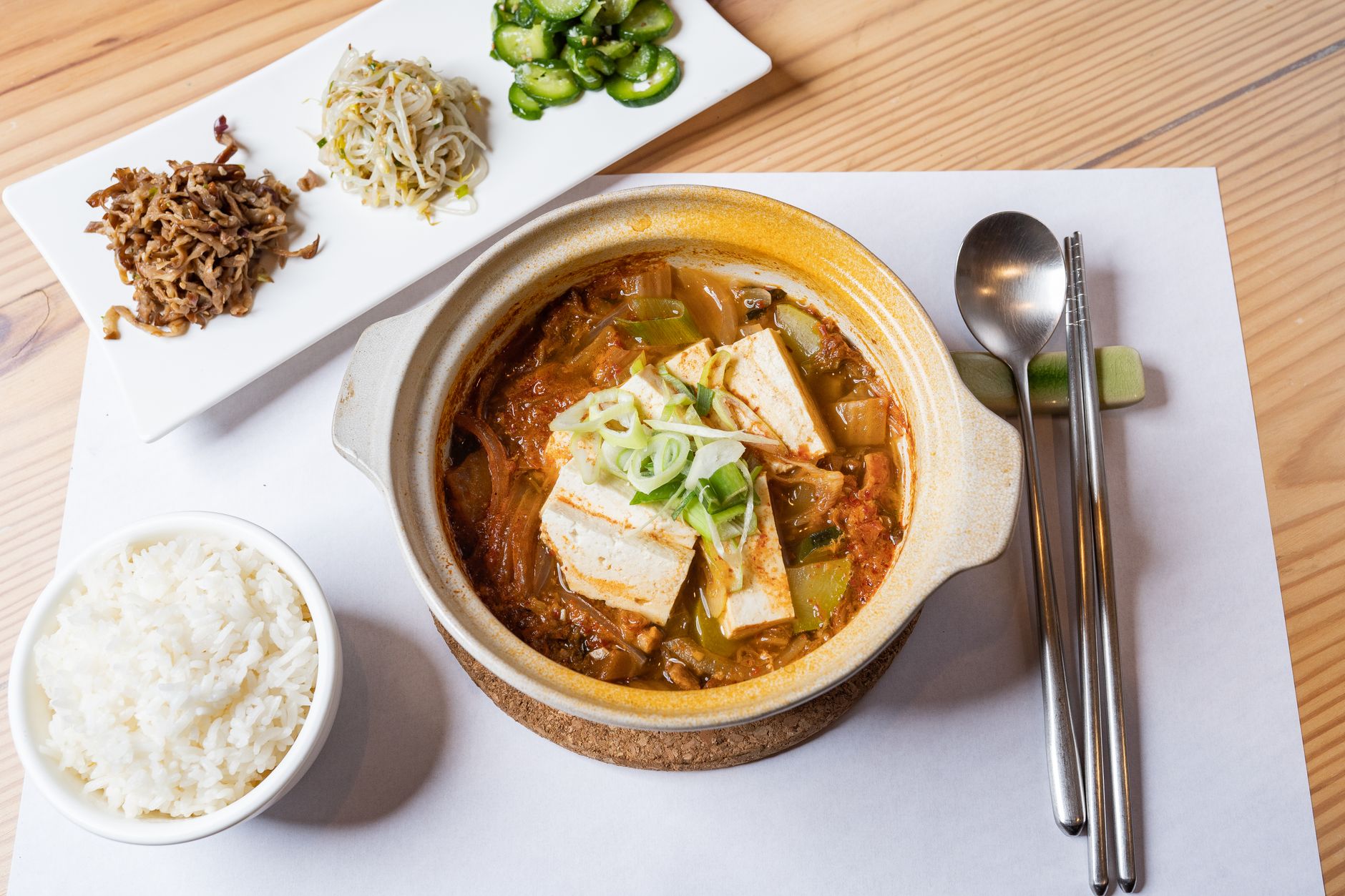
Order guk or tang if you want a single bowl of broth to eat with rice, jjigae if you want a stronger, saltier stew, and jeongol if you are sharing a hot pot assembled at the table. Korean menus use all four words constantly, and the English labels "soup" and "stew" hide the differences that actually decide what lands on your table.
Four Categories, Four Ways of Eating
Guk (국) is a lighter soup served as part of a standard meal, in an individual bowl next to your rice. The broth is usually clear and mildly seasoned, and the bowl holds more liquid than solid ingredients. Examples include miyeok-guk (seaweed soup), tteokguk (rice cake soup), and kongnamul-guk (bean sprout soup).
Tang (탕) is closer to guk, and the line between them is genuinely blurry. In practice, tang usually refers to a heartier, longer-simmered soup, often built on bones or meat, and it is common as a restaurant specialty. Examples include galbitang (short rib soup), seolleongtang (ox bone soup), and samgyetang (ginseng chicken soup). Many restaurants that serve tang offer a single-portion bowl with rice.
Jjigae (찌개) is a stew. It contains less liquid than a soup, with a thicker, saltier, and more strongly seasoned broth. Kimchi, doenjang (fermented soybean paste), or gochujang (chili paste) usually provide the flavor. It arrives bubbling in a small earthenware pot (ttukbaegi) and is often shared at the center of the table, though many restaurants serve a single-portion set at lunch. Examples include kimchi-jjigae, doenjang-jjigae, and sundubu-jjigae (soft tofu stew).
Jeongol (전골) is a hot pot cooked at the table. Raw ingredients such as vegetables, tofu, noodles, and meat are arranged in a wide, shallow pot, then broth is added and the pot is set over a portable burner. It is communal by design and usually ordered for two or more people. Mandu-jeongol (dumpling hot pot) is a classic example. Budae-jjigae (army stew) carries the name jjigae but is served in the jeongol style.
The names are not strict. A dish called tang can taste like a stew, and a dish called jjigae can arrive as a hot pot. When in doubt, look at how it is served: individual bowl, bubbling pot, or table-top burner.
| Category | Broth | Seasoning | How It Is Served | Examples |
|---|---|---|---|---|
| Guk | Thin, often clear | Mild, salt or soy-based | Individual bowl beside rice | Miyeok-guk, tteokguk |
| Tang | Rich, long-simmered | Mild to medium | Individual bowl or shared pot | Galbitang, samgyetang |
| Jjigae | Thick, little liquid | Strong, salty, often spicy | Bubbling earthenware pot | Kimchi-jjigae, sundubu-jjigae |
| Jeongol | Added at the table | Medium, varies by pot | Shared pot over a table burner | Mandu-jeongol, budae-jjigae |
Which One to Order
Match the category to the situation.
- Eating alone: Choose guk or tang. Restaurants known as gukbap shops specialize in a single bowl of soup with rice, so you will not run into a two-person minimum. Our solo dining guide covers the places where that minimum does apply, and jeongol is the most likely to require it.
- Cold or rainy day: Choose jjigae. The stronger seasoning and the heat of the pot are the point.
- Feeling unwell or wanting something gentle: Choose a clear guk, such as tteokguk, or a mild tang.
- A group dinner: Choose jeongol. It turns the meal into a shared, slow, interactive event.
Rice is the other half of every one of these dishes. A bowl of guk, tang, or jjigae is almost never eaten on its own. It arrives with a bowl of steamed rice and a few side dishes, and the usual way to eat is to alternate spoonfuls of broth with rice. Some people add the rice directly into the soup, which is a common way to finish a bowl of tang, and it is a normal and accepted habit rather than a mistake. In gukbap shops, the rice may already be served inside the soup.
Spiciness is the other thing to check. Many jjigae are spicy by default, while most guk and tang are not. If you want to avoid heat, ask whether the dish is spicy before you order.
Step-by-Step: Ordering Without Surprises
- Step 1: Read the ending. Look at the last syllable of the dish name on the menu: 국, 탕, 찌개, or 전골. It tells you the category immediately.
- Step 2: Check the portion. Look for the word 1인분 (il-inbun, "one serving") on the menu. Jeongol is commonly listed as 2인분 or larger.
- Step 3: Ask about spice. Say 안 매워요? (an maewoyo?, "Is it not spicy?") before you commit.
- Step 4: Wait for the pot. Jjigae arrives hot enough to keep boiling at the table, so let it settle before the first spoonful.
- Step 5: Eat with the spoon. Use the spoon for broth and rice, and use chopsticks for the solid ingredients and side dishes.
Once the four endings stick, a Korean menu becomes much easier to read. You will know which bowl is for one, which pot is for sharing, and which dish is going to be spicy before it arrives.