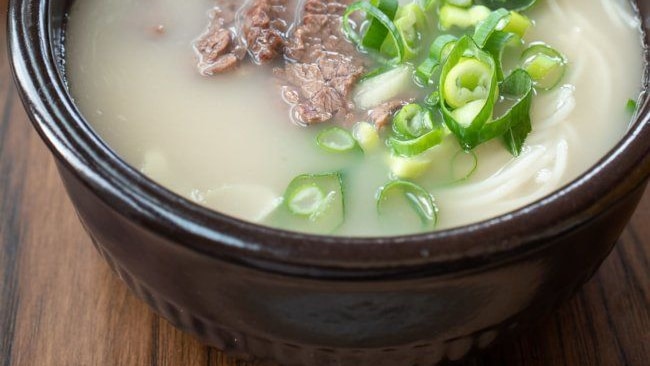
Seolleongtang (설렁탕) and gomtang (곰탕) are slow-simmered beef soups served with rice, and both arrive deliberately unseasoned. Add salt, pepper and green onion at the table, and pour in a little radish kimchi juice if you want tang.
Key Takeaways
- Seolleongtang: milky white broth from long-boiled bones
- Gomtang: clearer, meatier broth from beef and some bones
- Season yourself: salt, pepper and green onion are on the table
- Avoid: judging the soup before seasoning; it tastes flat on purpose
Seolleongtang vs gomtang
| Seolleongtang | Gomtang | |
|---|---|---|
| Broth | Milky white, from bones boiled for many hours | Clearer, from meat and some bones |
| Flavor | Deep, mellow, rich | Clean, meaty |
| Inside | Sliced beef, thin wheat noodles (somyeon) | Sliced beef, sometimes tripe |
| Famous for | Seoul | Naju (Naju gomtang) |
| Price | Around 10,000–15,000 KRW | Around 11,000–16,000 KRW |
Seasoning at the table
| Seasoning | How much | Why |
|---|---|---|
| Salt (소금) | Start with a small pinch, taste, adjust | The broth comes with no salt |
| Black pepper | A light shake | Adds warmth |
| Green onion (파) | A generous spoonful | Freshness and color |
| Kkakdugi juice | A spoonful or two | Adds tang and a little heat |
How to eat it
- Taste the broth plain first.
- Add salt and pepper gradually, then green onion.
- Eat the noodles first if your bowl includes somyeon.
- Add the rice to the broth, or eat it spoonful by spoonful.
- Alternate bites with kimchi and kkakdugi.
설렁탕 두 그릇 주세요.
Seolleongtang du geureut juseyo.
Two bowls of seolleongtang, please.
특으로 드릴까요, 보통으로 드릴까요?
Teugeuro deurilkkayo, botongeuro deurilkkayo?
Large (special) or regular?
보통으로 주세요.
Botongeuro juseyo.
Regular, please.
깍두기 좀 더 주세요.
Kkakdugi jom deo juseyo.
A bit more radish kimchi, please.
Related beef soups
Seolleongtang and gomtang belong to a family of Korean beef soups. Once you know the two, the others on the menu are easy to read.
| Soup | Korean | What it is | Spice |
|---|---|---|---|
| Doganitang | 도가니탕 | Beef knee cartilage soup, rich and gelatinous | None |
| Galbitang | 갈비탕 | Beef short rib soup, clear and meaty | None |
| Yukgaejang | 육개장 | Shredded beef with bracken in a spicy red broth | Hot |
| Kkori gomtang | 꼬리곰탕 | Oxtail soup, deep and premium | None |
| Haejangguk | 해장국 | "Hangover soup", often with beef blood or cabbage | Mild to medium |
If you're avoiding spice, every soup above except yukgaejang is a safe choice. Many seolleongtang restaurants serve several of these, so the menu board is a good place to try something new on a second visit.
Sizes and extras
| Option | Korean | What you get |
|---|---|---|
| Regular | 보통 | Standard portion of meat |
| Special / large | 특 | More meat, a few thousand won extra |
| Extra noodles | 사리 추가 | More somyeon in the broth |
| Extra rice | 공깃밥 추가 | Another bowl of rice |
Do
- Taste before seasoning
- Add green onion generously
- Try a spoonful of kkakdugi juice in the broth
- Order 특 (special) if you're very hungry
Don't
- Salt heavily at the start
- Call the soup bland before you've seasoned it
- Skip the kimchi; it balances the rich broth
- Expect a spicy soup
More soups: gukbap and juk, samgyetang, and guk vs tang vs jjigae.
Frequently Asked Questions
Why is seolleongtang so bland? It's served unseasoned so each person can adjust the salt to taste. Add salt, pepper and green onion at the table.
What makes the broth white? Beef bones are boiled for many hours, releasing collagen and marrow that turn the broth milky.
Is seolleongtang good for a hangover? Many Koreans think so. It's warm, mild and filling, and seolleongtang shops often open early in the morning.
What does 특 mean on the menu? 특 (teuk) means "special": a larger bowl with more meat, for a little more money.