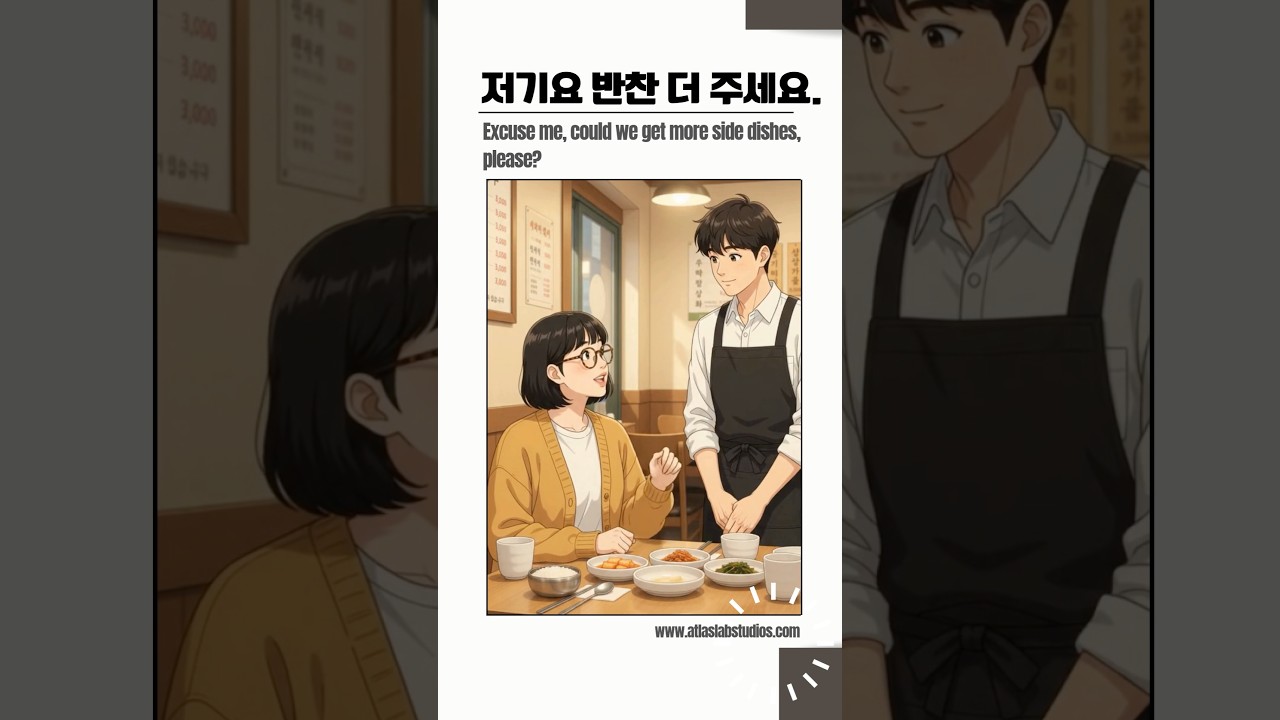
You sit down at a Korean restaurant. Before you've ordered anything, six small plates land on your table — kimchi, bean sprouts, pickled radish, seasoned spinach.
Nobody explained them. They aren't on the menu. And the first question every visitor has is the same one: am I going to be charged for these?
The short answer
No. They're free, and so are the refills.
These are 반찬 (banchan), and they come with the meal. You didn't order them, you can't decline them, and you won't find them on the bill.
Refills are free too, and asking for more is completely normal. Koreans do it constantly.
Why this feels strange
In most countries, anything that arrives at your table gets charged. Bread costs money. Olives cost money. So six unordered plates trigger an alarm.
Korean restaurants work differently. Banchan isn't an appetizer or a side order — it's considered part of a proper meal. A bowl of rice, a soup, and several banchan is the basic shape of Korean dining, and the restaurant is just serving the meal correctly.
Charging for a refill would be like a Western restaurant charging you for a second slice of the bread it put on your table.
How to ask for more
There's one phrase that covers it:
더 주세요 — deo ju-se-yo — "please give me more"
Point at the empty dish and say it. That's the whole interaction.
If you want to be more specific:
| Korean | Romanization | Meaning |
|---|---|---|
| 더 주세요 | deo ju-se-yo | Please give me more |
| 반찬 더 주세요 | ban-chan deo ju-se-yo | More side dishes, please |
| 김치 더 주세요 | kim-chi deo ju-se-yo | More kimchi, please |
| 이거 더 주세요 | i-geo deo ju-se-yo | More of this, please |
이거 means "this thing," so 이거 더 주세요 works for anything you can point at. If you learn one version, learn that one.
To get someone's attention first, say 저기요 (jeo-gi-yo) — the Korean equivalent of "excuse me." Say it clearly across the room. That's not rude here; it's how it's done.
Here's how the whole exchange sounds in a real restaurant:
Self-serve or served
Some restaurants have a 셀프바 (self bar) — a small station near the counter with banchan, water, and sometimes soup. If you see one, get up and help yourself.
If you don't see one, staff will bring refills to your table.
A useful question: 셀프예요? (sel-peu-ye-yo?) — "Is it self-serve?"
Where free stops
A few exceptions are worth knowing.
Premium banchan. At some restaurants, one or two dishes are marked with a price — steamed egg, a small salad, a seafood item. These are on the menu, so check before assuming.
Refills of expensive items. Free refills apply to standard banchan. If a place serves raw crab or a large piece of grilled fish as a side, that's not getting refilled for free.
All-you-can-eat places. Buffet-style or 무한리필 restaurants have their own rules, usually posted.
In an ordinary restaurant, none of this will come up. Kimchi, sprouts, radish, and greens are always free.
Don't over-order
One thing Koreans do care about is waste. Banchan that gets thrown away is a real issue, and asking for a refill you won't finish is mildly frowned upon.
Ask for more of what you're actually eating. Nobody will comment if you refill kimchi three times and never touch the spinach.
Water works the same way
Water is free, and it's often self-serve too — a dispenser or a fridge near the entrance with pitchers and metal cups. If nobody brings water to your table, that's why.
물 주세요 — mul ju-se-yo — "water, please" — works if you'd rather ask.
Korean restaurants also default to cold water. If you want it warm, 따뜻한 물 주세요 (tta-tteu-tan mul ju-se-yo).
The words behind all of this
Ten words cover most of what happens at a Korean table:
반찬 · 김치 · 더 · 주세요 · 저기요 · 물 · 셀프 · 무료 · 그릇 · 리필
What to actually do
- Sit down. Banchan arrives without you doing anything
- Eat whatever looks good — you can't order it wrong
- When something runs out, point and say 더 주세요
- Look for a self-serve station before flagging someone down
- Don't stress about the bill. It's the food you ordered, nothing else
The banchan is genuinely one of the better parts of eating in Korea, and it costs nothing. Use it.
저기요 and 더 주세요 are the kind of short phrases that do enormous work in real situations. K-PATTO teaches 300+ of them through a webtoon story set in Seoul, with native audio on every line. The first ten episodes are free.