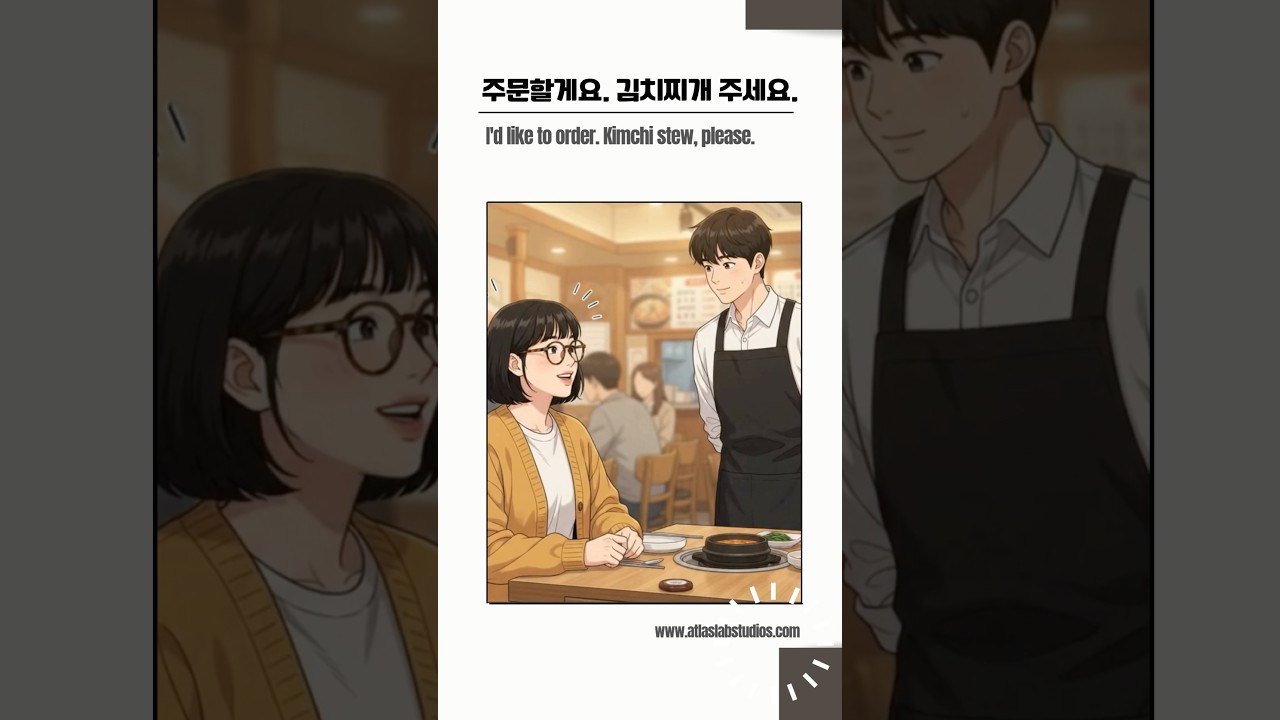
You've been sitting for ten minutes. Staff walk past your table repeatedly. Nobody stops. Nobody makes eye contact. You start wondering if you've done something wrong.
You haven't. You just haven't called them yet.
The rule that changes everything
In most Western restaurants, a server checks on you. They approach, ask how everything is, and refill your water unprompted. Not calling attention to yourself is the polite default.
Korean restaurants invert this completely. Staff do not come to your table unless you call them.
This isn't neglect. It's considered polite — you're being left alone to eat and talk without interruption. Nobody hovers, nobody asks how the first bite was.
The flip side is that you have to initiate every single interaction. Ordering, refills, the bill. All of it starts with you.
The two ways to call
The button. Many restaurants have a small round call button on the table edge or the wall beside your seat. Press it once. A chime sounds at the counter with your table number, and someone comes over.
Press once and wait. Pressing repeatedly is the one thing that actually reads as rude.
Your voice. If there's no button, you say it:
저기요 — jeo-gi-yo — "excuse me"
Say it out loud, across the room, loud enough to carry. This is the part that feels wrong to most visitors, and it shouldn't. It's the standard way, used by everyone, in every kind of restaurant.
Here's what that looks like in practice:
How loud is too loud
The honest answer: louder than you think, and quieter than you fear.
You're not shouting across a stadium. You're projecting enough that someone twenty feet away hears you over the noise of a busy room. Koreans do this without a second thought and nobody looks up.
If nobody responds, say it again. Not louder — just again.
What comes next
Once you've called, the exchange is short:
| Korean | Romanization | Meaning |
|---|---|---|
| 저기요 | jeo-gi-yo | Excuse me |
| 주문할게요 | ju-mun-hal-ge-yo | I'd like to order |
| 이거 주세요 | i-geo ju-se-yo | This one, please |
| 하나 주세요 | ha-na ju-se-yo | One, please |
| 둘 주세요 | dul ju-se-yo | Two, please |
You can order by pointing at the menu and saying 이거 주세요. That works everywhere and requires no vocabulary at all.
For quantity, Korean uses its own counting numbers here: 하나, 둘, 셋. 김치찌개 하나 주세요 — one kimchi stew, please.
What you'll hear back
Two responses cover most cases:
네, 부르셨어요? — ne, bu-reu-syeoss-eo-yo? — "Yes, did you call?"
잠시만요 — jam-si-man-yo — "Just a moment"
The second one means they heard you and are coming. You don't need to call again.
Other ways people call
사장님 (sa-jang-nim) — literally "boss," used for the owner. Common at small family-run places and it sounds warm rather than formal.
이모 (i-mo) — literally "aunt," used for older female staff at casual restaurants. Affectionate and very common, though it's better to hear it used a few times before trying it yourself.
저기요 is safe everywhere. Start there.
The words behind all of this
Ten words cover calling, ordering, and the reply you'll get:
저기요 · 벨 · 주문 · 메뉴 · 하나 · 둘 · 김치찌개 · 잠시만요 · 네 · 사장님
What to actually do
- Sit down. Nobody is coming yet, and that's normal
- Look for a button on the table edge or wall
- No button? Say 저기요 loudly, once
- When they arrive, point at the menu: 이거 주세요
- For more than one, add 하나 or 둘
The silence at the start isn't bad service. It's the system waiting for you to speak first.
저기요 is probably the single most useful word for a traveler in Korea. K-PATTO teaches 300+ phrases like it through a webtoon story set in Seoul, with native audio on every line. The first ten episodes are free.