Korean convenience stores are not just places to buy things. Most have a counter by the window, a hot water dispenser, a microwave, and people eating at ten at night.
Cup ramen there costs about 1,500 won and is a genuine meal. The whole system runs on two questions.
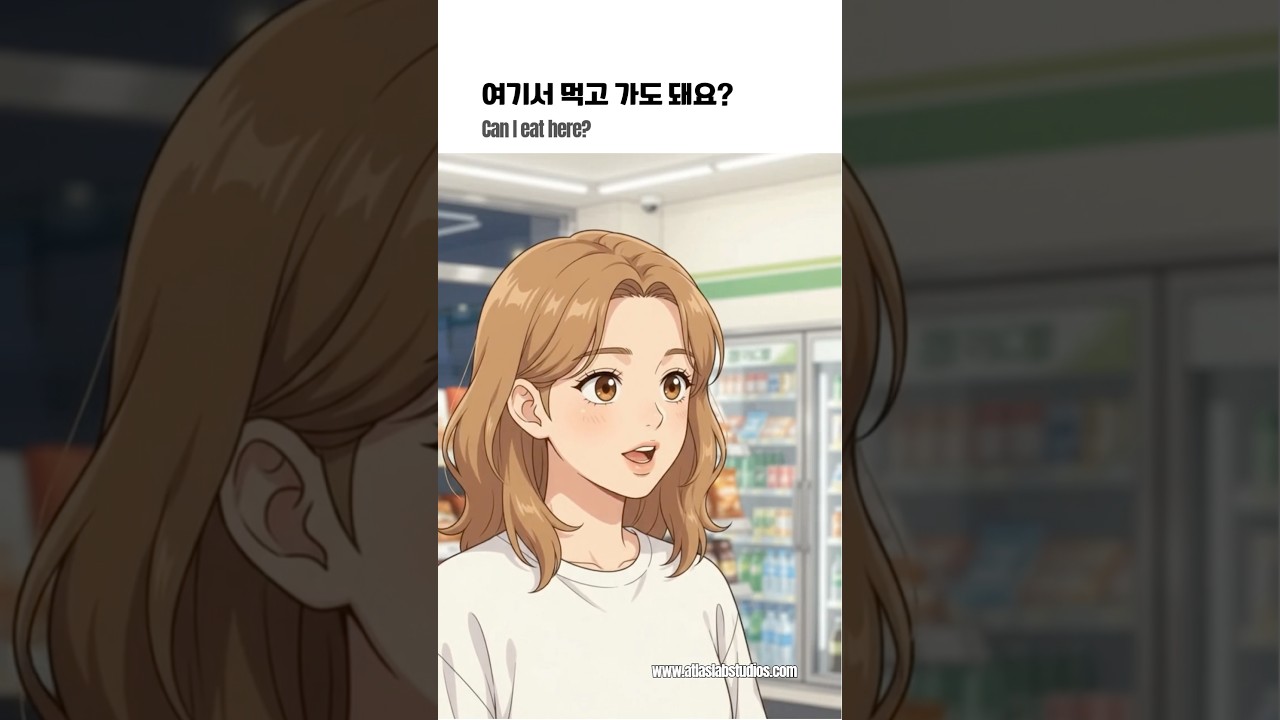
Can you eat inside?
여기서 먹고 가도 돼요? yeo-gi-seo meok-go ga-do dwae-yo? "Can I eat here?"
You'll almost always get yes. Look for a narrow counter facing the window or a few stools near the entrance.
You don't strictly have to ask — people just sit down. But asking tells you whether this particular branch has seating, and it's the polite move.
Where the hot water is
뜨거운 물은 어디 있어요? tteu-geo-un mul-eun eo-di iss-eo-yo? "Where's the hot water?"
There's a dispenser near the microwave, usually a stainless steel box with a spout and a button. Free, and nobody checks whether you bought the ramen there.
| Korean | Romanization | Meaning |
|---|---|---|
| 뜨거운 물 | tteu-geo-un mul | hot water |
| 전자레인지 | jeon-ja-re-in-ji | microwave |
| 젓가락 | jeot-ga-rak | chopsticks |
| 뚜껑 | ttu-kkeong | lid |
| 국물 | gung-mul | broth |
The thing nobody tells you
Cup ramen does not come with chopsticks.
There's a bin of disposable wooden chopsticks near the counter or the microwave. Grab a pair before you pour the water, or you'll be standing there watching your noodles cook with nothing to eat them with.
Staff will often remind you — 젓가락도 가져가세요 (jeot-ga-rak-do ga-jyeo-ga-se-yo, "take chopsticks too") — but not always.
The actual steps
- Pick your cup ramen and pay at the counter
- Grab chopsticks from the bin
- Peel the lid back to the marked line, not all the way off
- Fill with hot water to the inside line
- Close the lid and wait — 3 minutes for most, 4 for thicker noodles
- Eat at the counter
Some branches have a small weight to hold the lid down. If not, the chopsticks across the top work.
What to add
This is where it gets good. The convenience store is a pantry, and people build on the base:
- A slice of 치즈 (cheese) melted on top of spicy ramen
- A 삼각김밥 (triangle kimbap) dipped in the broth
- A boiled egg from the counter by the register
- 만두 (dumplings) microwaved and dropped in
None of this is unusual. It's what the setup is for.
Disposing of it
Look for a bin with a hole for liquid — you pour the leftover broth there, then put the cup in the trash. Don't pour broth into the regular bin.
If you can't find it: 국물은 어디에 버려요? — "Where do I pour the broth?"
Which ones to try
| Korean | What it is |
|---|---|
| 신라면 | The default. Spicy, beef-based |
| 진라면 | Milder. Comes in 매운맛 (spicy) and 순한맛 (mild) |
| 짜파게티 | Black bean noodles, not soup |
| 불닭볶음면 | Very spicy stir-fried. Not for a first try |
| 육개장 | Cup only. Thin noodles, beef broth |
If you want something that isn't spicy, ask 안 매운 거 있어요? — "Do you have something not spicy?"
What to actually do
- Ask 여기서 먹고 가도 돼요?
- Get chopsticks before anything else
- Ask 뜨거운 물은 어디 있어요?
- Fill to the line, wait three minutes
- Pour the broth in the liquid bin, cup in the trash
It's one of the cheapest and most ordinary things you can do in Korea, and it's worth doing at least once at midnight.
The small practical exchanges are what daily life here actually sounds like. K-PATTO teaches 300+ phrases through a webtoon story set in Seoul, with native audio on every line. The first ten episodes are free.