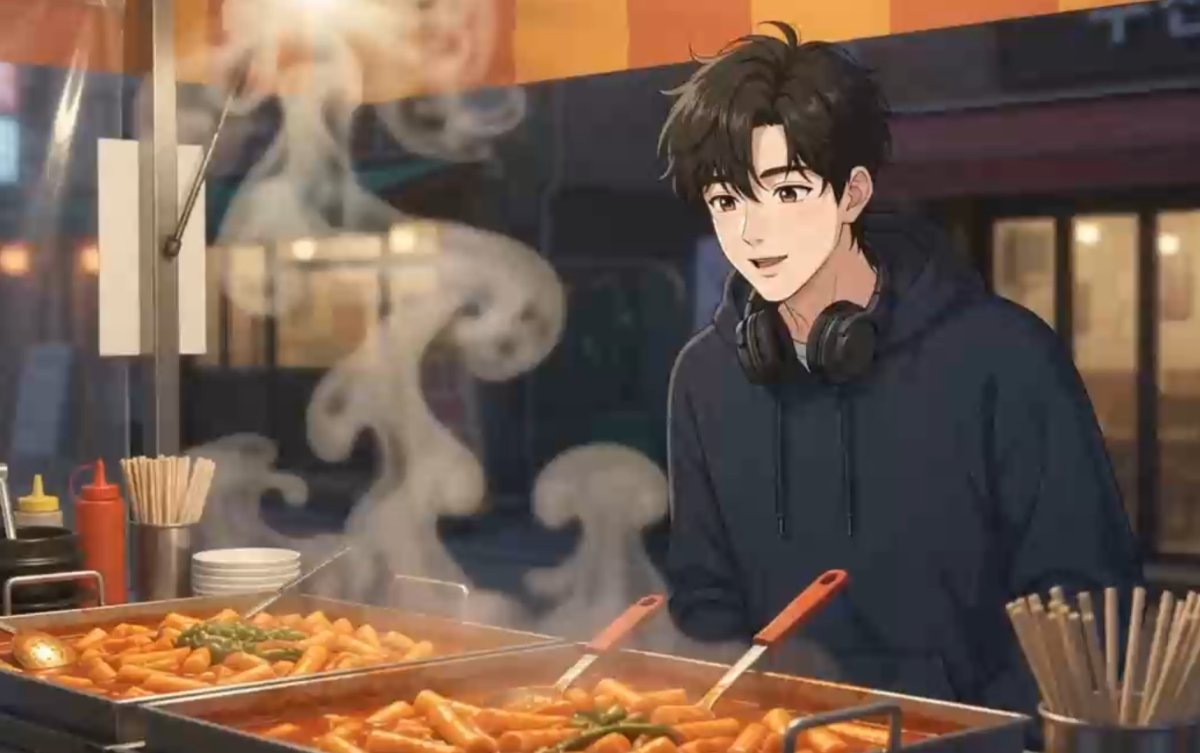
Street food stalls are where Korean gets practical. There is no English menu, the queue is moving, and pointing works but only gets you so far.
The good news is that the whole exchange is four or five short sentences, and the same ones work at every stall in the country.
Ordering
이거 주세요 — this one, please — with a point, covers most situations.
To be more specific:
- 떡볶이 주세요. — Tteokbokki, please.
- 하나 주세요. — One, please.
- 이인분 주세요. — Two portions, please.
분 is the counter for portions of food. 일인분, 이인분, 삼인분.
The spice question
This is the one that matters at a tteokbokki stall.
- 매워요? — Is it spicy?
- 많이 매워요? — Is it very spicy?
- 안 맵게 해 주세요. — Please make it not spicy.
- 조금만 맵게 해 주세요. — Just a little spicy, please.
Be aware that 안 매워요 from a Korean vendor may still be spicy by other standards. If you genuinely cannot handle heat, say so directly:
- 매운 거 못 먹어요. — I can't eat spicy food.
못 먹어요 is also how you handle allergies and restrictions: 돼지고기 못 먹어요 — I can't eat pork.
Eating there or taking it
- 여기서 먹을게요. — I'll eat here.
- 포장해 주세요. — Please pack it up.
Many stalls have a small standing counter. If there is no space, 포장 is the default.
Paying
- 얼마예요? — How much is it?
- 다 해서 얼마예요? — How much altogether?
- 카드 돼요? — Do you take card?
That last one matters. Small stalls and market vendors sometimes take cash only, and it is worth asking before you order rather than after.
What is on the menu
| Korean | What it is |
|---|---|
| 떡볶이 | rice cakes in spicy sauce |
| 순대 | blood sausage |
| 튀김 | fried things — vegetables, squid, dumplings |
| 어묵 | fish cake, usually on a skewer in broth |
| 김밥 | rice roll in seaweed |
| 라면 | instant noodles |
| 만두 | dumplings |
| 핫도그 | corn dog, not a hot dog |
어묵 deserves a note: the broth it sits in is free, and there are usually paper cups by the pot. Taking one is expected, not cheeky.
튀김 is normally sold by the piece. 이거 하나, 저거 두 개 — pointing plus numbers is completely normal here.
Counting
Street food uses native Korean numbers with counters.
| Number | With 개 (things) | |
|---|---|---|
| 1 | 하나 | 한 개 |
| 2 | 둘 | 두 개 |
| 3 | 셋 | 세 개 |
| 4 | 넷 | 네 개 |
| 5 | 다섯 | 다섯 개 |
Note that 하나, 둘, 셋, 넷 change form before a counter. 한 개, not 하나 개.
Prices, however, use the other number system: 삼천 원 (3,000 won). Korean uses two number systems and this is one of the places you meet both in the same sentence.
A full exchange
You: 떡볶이 하나 주세요. Vendor: 매운 거 괜찮으세요? You: 조금만 맵게 해 주세요. Vendor: 네. You: 얼마예요? Vendor: 사천 원이요.
See it happen
Episode 3 of K-PATTO is set at a tteokbokki stall, where Emma orders for the first time and gets talked into trying something she did not plan on. Every line has audio, and the vendor speaks at the speed a real one would.
The first ten episodes are free at K-PATTO.