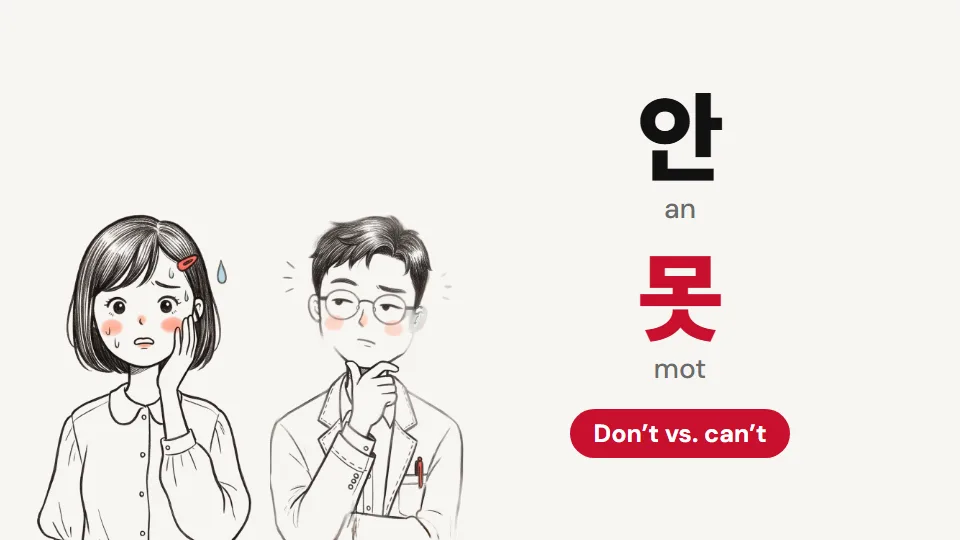
"I don't eat meat" and "I can't eat meat" are different sentences, and Korean makes you choose with one syllable: 안 or 못. Picking the wrong one can turn a polite refusal into a rude one.
The split
Both words go right before the verb, and both mean "not." The difference is why.
- 안 — you don't, by choice or habit, or simply because it isn't so.
- 못 — you can't, because of ability or circumstance.
| Korean | Romanization | Meaning |
|---|---|---|
| 안 가요. | an gayo | I'm not going. (I choose not to.) |
| 못 가요. | mot gayo | I can't go. (Something stops me.) |
| 안 먹어요. | an meogeoyo | I don't eat it. (My choice, or my habit.) |
| 못 먹어요. | mon meogeoyo | I can't eat it. (Allergy, too spicy, no appetite.) |
Notice that 못 먹어요 sounds like "mon meogeoyo." The final ㅅ in 못 turns into an n sound before ㅁ and ㄴ. You'll hear it constantly.
안 for choices and facts, 못 for what stops you
| 안 | 못 |
|---|---|
| 고기를 안 먹어요. (I don't eat meat.) | 땅콩을 못 먹어요. (I can't eat peanuts: allergy.) |
| 커피를 안 마셔요. (I don't drink coffee.) | 수영을 못 해요. (I can't swim.) |
| 안 매워요. (It isn't spicy.) | 오늘은 못 가요. (I can't go today.) |
Adjectives only take 안: 안 매워요, 안 예뻐요. An adjective can't be an ability, so 못 매워요 isn't Korean. For 이다 ("to be"), the negative is 아니에요: 학생이 아니에요 ("I'm not a student").
The same verb, two meanings
| 안 | 못 |
|---|---|
| 안 갔어요. I didn't go. | 못 갔어요. I couldn't go. |
| 안 봤어요. I didn't watch it. | 못 봤어요. I couldn't see it. |
| 안 왔어요. He didn't come. | 못 왔어요. He couldn't come. |
| 한국어를 안 해요. I don't speak Korean (by choice). | 한국어를 못 해요. I can't speak Korean. |
The last row is the one that matters most for beginners. If you tell someone 한국어를 안 해요, they'll hear that you choose not to speak Korean, which can sound like a refusal. 한국어를 못 해요 is what you want. See also how the past tense attaches to both.
Why 못 is the polite refusal
Koreans often decline invitations with 못 rather than 안, even when they simply don't feel like going.
- 안 갈래요. — I don't want to go. (A flat no that states your own wish.)
- 오늘은 못 가요. — I can't go today. (A soft no, with no explanation required.)
Saying you can't sounds gentler than saying you won't, because it removes the idea that the decision is yours. If you want to turn down an invitation without friction, 못 is the safer word.
Where it goes with 하다 verbs
Verbs ending in 하다 split in two. The negative goes between the noun and 하다.
- 공부 안 해요. — I don't study.
- 운동 못 해요. — I can't exercise.
- ✗ 안 공부해요 — wrong.
This is the single most common error in written Korean from learners. The reason is that 공부하다 is really 공부 (study) plus 하다 (do), and the negative slides in the middle.
The exception is when 하다 is built into the word as a single verb, such as 좋아하다 (like) or 싫어하다 (dislike). Those take 안 in front: 안 좋아해요.
The longer forms: -지 않다 and -지 못하다
You'll meet these in writing, in formal speech, and in announcements.
| Short | Long |
|---|---|
| 안 먹어요 | 먹지 않아요 |
| 못 먹어요 | 먹지 못해요 |
The long forms mean the same thing and sound more formal. They also let you negate long verbs without awkwardness: 도착하지 못했어요 (I couldn't arrive).
Common mistakes
| ✗ | ✓ | Why |
|---|---|---|
| 못 예뻐요 | 안 예뻐요 | Adjectives only take 안. |
| 한국어 안 해요 | 한국어 못 해요 | 안 sounds like you refuse. |
| 안 공부해요 | 공부 안 해요 | With 하다 verbs, the negative goes in the middle. |
| 안 이에요 | 아니에요 | 이다 has its own negative. |
For "can't" as a full pattern, including asking "can I…?", see -(으)ㄹ 수 있다 / 없다.