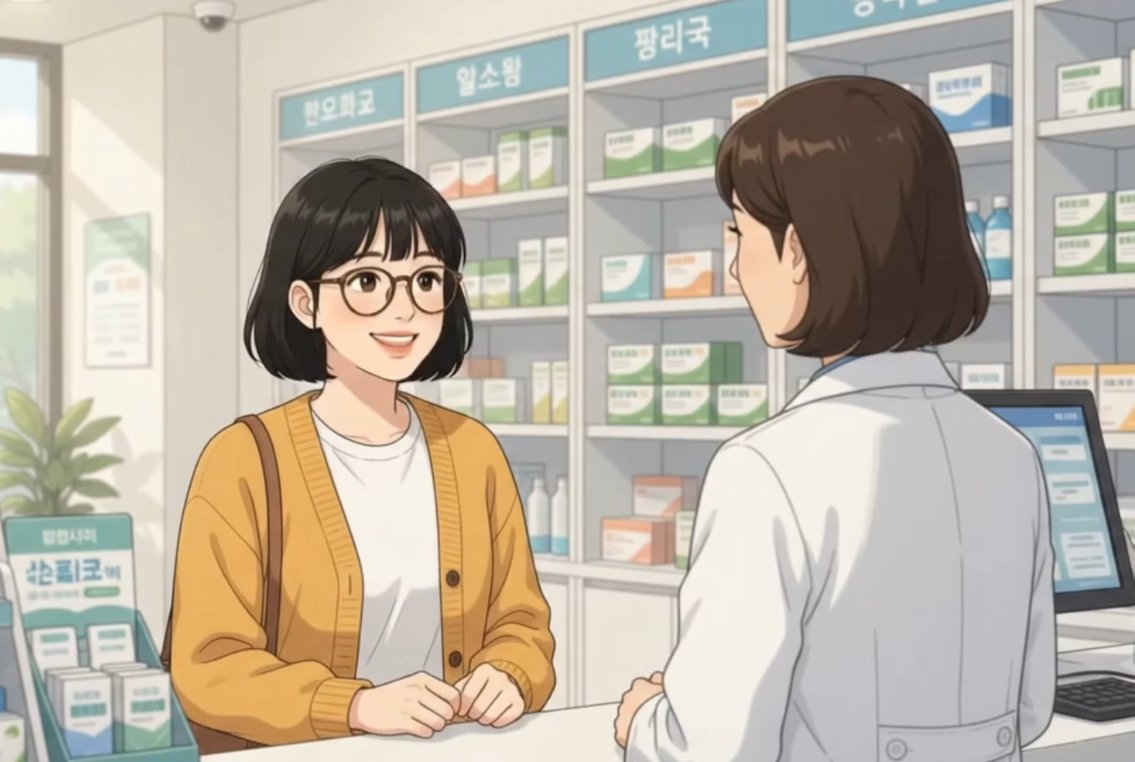
Korean pharmacies sell a lot over the counter: cold medicine, painkillers, stomach remedies, patches. You usually don't name a brand. You describe what's wrong, the pharmacist asks a question or two, and then chooses something for you. The conversation is short, but it is a conversation.
Finding one
Look for 약국 (yakguk) and a green cross. Most close in the evening, though some areas have late-night pharmacies. Late-night medicine in Korea explains where to go after hours. Convenience stores also sell a small range of basics, such as painkillers, cold medicine and digestive aids, around the clock.
Describing what's wrong
The pattern is ~이/가 아파요 ("~ hurts").
| Korean | Romanization | Meaning |
|---|---|---|
| 머리가 아파요. | meoriga apayo | I have a headache. |
| 배가 아파요. | baega apayo | I have a stomachache. |
| 목이 아파요. | mogi apayo | I have a sore throat. |
| 열이 나요. | yeori nayo | I have a fever. |
| 기침을 해요. | gichimeul haeyo | I have a cough. |
| 콧물이 나요. | konmuri nayo | I have a runny nose. |
| 소화가 안 돼요. | sohwaga an dwaeyo | I have indigestion. |
| 설사를 해요. | seolsareul haeyo | I have diarrhea. |
Asking for medicine
~ 있어요? ("do you have ~?") works for all of these.
| Korean | Romanization | What it is |
|---|---|---|
| 감기약 | gamgiyak | cold medicine |
| 진통제 | jintongje | painkiller |
| 해열제 | haeyeolje | fever reducer |
| 소화제 | sohwaje | digestive aid |
| 연고 | yeongo | ointment |
| 파스 | paseu | medicated patch |
| 밴드 | baendeu | adhesive bandage |
What the pharmacist will ask
| You'll hear | Meaning | Answer |
|---|---|---|
| 어디가 불편하세요? | What's bothering you? | 목이 아파요. |
| 기침도 하세요? | Do you have a cough too? | 네, 조금요. |
| 언제부터 그러셨어요? | Since when? | 어제부터요. |
| 알레르기 있으세요? | Any allergies? | 아니요, 없어요. |
| 드시는 약 있으세요? | Are you taking any medicine? | 아니요. |
Short answers are fine: 네, 아니요, 어제부터요 ("since yesterday").
Understanding the instructions
This is the part worth learning properly, because it comes at the end, when you've stopped concentrating.
| You'll hear | Meaning |
|---|---|
| 하루 세 번 드세요. | Take it three times a day. |
| 식후에 드세요. | Take it after meals. |
| 식전에 드세요. | Take it before meals. |
| 이건 좀 졸려요. | This one makes you drowsy. |
| 운전하시면 안 돼요. | You shouldn't drive. |
식후 (sikhu, after eating) and 식전 (sikjeon, before eating) are on almost every packet. If you didn't catch it, ask 다시 한번 말해 주세요 ("please say that again").
Polite or casual?
Pharmacists use honorific -시- with you (드세요, 있으세요?). Polite -요 is all you need back. With a friend: 나 감기 걸렸어 ("I've caught a cold").
A full visit
You: 목이 아픈데, 감기약 있어요?
Pharmacist: 기침도 하세요?
You: 네, 조금요.
Pharmacist: 이건 졸려요. 운전하시면 안 돼요.
You: 그럼 밤에 먹을게요.
Pharmacist: 하루 세 번, 식후에 드세요.
More health guides: seeing a doctor · emergency numbers