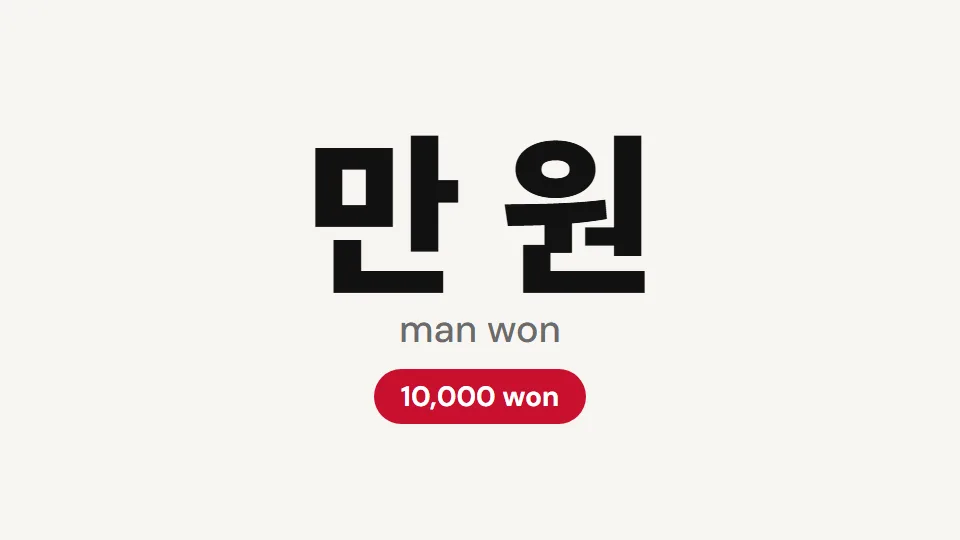
Korean prices look familiar on a tag: 12,900원, ₩35,000. The trouble starts when someone says them out loud. English groups big numbers by the thousand; Korean groups them by the ten thousand, so 35,000 comes out as "three ten-thousands and five thousand". Once that clicks, every price is easy to read and to hear.
The units
Money always uses Sino-Korean numbers (일, 이, 삼, 사, 오…), never native ones. The place-value words are:
| Value | Korean | Romanization |
|---|---|---|
| 10 | 십 | sip |
| 100 | 백 | baek |
| 1,000 | 천 | cheon |
| 10,000 | 만 | man |
| 100,000 | 십만 | simman |
| 1,000,000 | 백만 | baengman |
| 10,000,000 | 천만 | cheonman |
| 100,000,000 | 억 | eok |
The key row is 만. Korean has no single word for "a hundred thousand" or "a million." Those are 십만 (ten 만) and 백만 (a hundred 만).
One more rule: when the number in front of 십, 백, 천 or 만 is one, you drop it. It's 천 원, not 일천 원, and 만 원, not 일만 원.
Reading any price in two steps
- Cut the number four digits from the right. 35,000 becomes 3 | 5000.
- Read the left part + 만, then the right part. 삼만 + 오천 = 삼만 오천 원.
| On the tag | Split | Say it |
|---|---|---|
| 3,500원 | 3500 | 삼천오백 원 |
| 9,900원 | 9900 | 구천구백 원 |
| 12,900원 | 1 | 2900 | 만 이천구백 원 |
| 50,000원 | 5 | 0000 | 오만 원 |
| 128,000원 | 12 | 8000 | 십이만 팔천 원 |
| 1,500,000원 | 150 | 0000 | 백오십만 원 |
Korean banknotes come in 1,000, 5,000, 10,000 and 50,000 won, so the words 천 원, 오천 원, 만 원, 오만 원 are the four you'll hear most at a till.
To get a feel for what those amounts buy, from street food to a sit-down meal, try the Korean Won Price Sense tool.
At the counter
| Korean | Romanization | Meaning |
|---|---|---|
| 이거 얼마예요? | igeo eolmayeyo? | How much is this? |
| 다 해서 얼마예요? | da haeseo eolmayeyo? | How much is it altogether? |
| 카드 돼요? | kadeu dwaeyo? | Can I pay by card? |
| 현금으로 할게요. | hyeongeumeuro halgeyo | I'll pay in cash. |
| 영수증 주세요. | yeongsujeung juseyo | A receipt, please. |
Staff usually answer with the total and the word 입니다 or 이에요: 만 이천 원입니다 ("That's 12,000 won").
Haggling, briefly
Fixed prices are the norm in shops, cafes and convenience stores. In traditional markets and some street stalls, a friendly ask is fine:
- 조금만 깎아 주세요. — jogeumman kkakka juseyo — Could you knock a little off?
- 두 개 사면 얼마예요? — du gae samyeon eolmayeyo? — How much if I buy two?
Don't try it in department stores or chains. The counters guide covers 두 개 and the other counters you'll need when buying more than one, and the market guide has the rest of the market phrases.
Common mistakes
| ✗ | ✓ | Why |
|---|---|---|
| 십천 원 | 만 원 | 10,000 has its own word. |
| 일천 원, 일만 원 | 천 원, 만 원 | Drop the "one" before 천 and 만. |
| 다섯 천 원 | 오천 원 | Money is always Sino-Korean. |
| 백이십팔천 | 십이만 팔천 | Split at 10,000, not at the comma. |