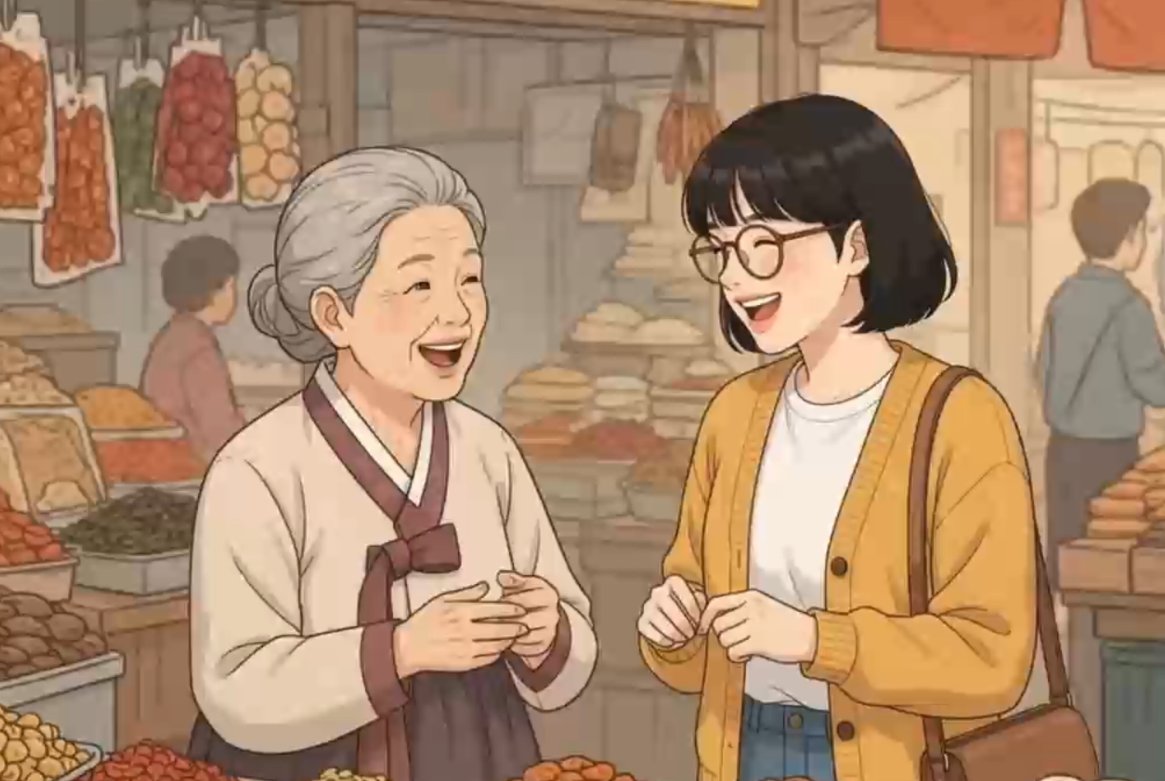
A traditional market is the one place in Korea where the price on the sign is not always the final price, where vendors will talk to you first, and where cash is still occasionally the only option.
It is also the best place to practice, because vendors are patient with foreigners and genuinely pleased when you try.
Browsing without committing
Vendors greet everyone who slows down. If you are just looking:
- 구경할게요. — I'm just looking around.
- 그냥 볼게요. — I'll just look.
Both are polite and completely normal. Nobody will be offended.
Asking about things
- 이거 뭐예요? — What is this?
- 이거 얼마예요? — How much is this?
- 맛있어요? — Is it good?
- 매워요? — Is it spicy?
- 먹어 봐도 돼요? — Can I try some?
That last one matters at food markets. Vendors offer samples freely, and asking is expected rather than pushy.
Asking for a discount
This works at traditional markets. It does not work at shops, department stores, or convenience stores — trying there is genuinely awkward.
- 좀 깎아 주세요. — Give me a little discount.
- 조금만 깎아 주세요. — Just a small discount.
- 좀 싸게 해 주세요. — Make it a bit cheaper.
Tone matters more than words. Said lightly, with a smile, while actually intending to buy, this is part of the normal exchange. Said aggressively, or when you have not decided, it lands badly.
Buying more improves your odds: 두 개 사면 얼마예요? — How much if I buy two?
덤: the free extra
Instead of dropping the price, vendors often add more product. That is 덤.
If you buy a bag of mandarins and the vendor drops in two extra, that is 덤. You do not have to ask for it, and thanking them is enough: 감사합니다.
You can also request it: 덤으로 좀 더 주세요.
Counters you will need
Markets use specific counters, and using the right one makes you sound far more competent than knowing extra vocabulary would.
| Counter | Used for |
|---|---|
| 개 | general items |
| 근 | 600g, used for meat and produce |
| 봉지 | bag |
| 팩 | pack |
| 마리 | fish, whole animals |
| 송이 | bunches (grapes, bananas) |
- 한 근 주세요. — One geun, please.
- 두 봉지 주세요. — Two bags, please.
근 catches people out. It is roughly 600g for meat and 375g for some other goods, and it is still the standard unit at markets even though shops use kilograms.
Paying
- 카드 돼요? — Do you take card?
- 현금 있어요. — I have cash.
- 계좌이체 돼요? — Can I transfer?
Most vendors take card now, but small stalls sometimes prefer cash and a few still only take it. Ask before you order rather than after.
A full exchange
Vendor: 어서 오세요! 뭐 찾으세요? You: 그냥 구경할게요. You: (later) 이거 얼마예요? Vendor: 한 봉지에 오천 원이요. You: 두 개 사면 좀 깎아 주세요. Vendor: 그럼 구천 원에 드릴게요. You: 감사합니다. 카드 돼요?
Where to go
광장시장 in Seoul is the famous one for food — bindaetteok, mayak gimbap, live octopus. Crowded and touristy, but the food is real.
남대문시장 is larger and more general — clothes, kitchenware, glasses, ginseng.
Neighbourhood markets are quieter and better for practicing, because vendors are not rushing through a queue.
See it happen
Episode 7 of K-PATTO is set in a traditional market, where Emma buys something from a vendor who has clearly been doing this for forty years. Every line has audio, including the vendor's — which sounds noticeably different from the young speakers in earlier episodes.
The first ten episodes are free at K-PATTO.