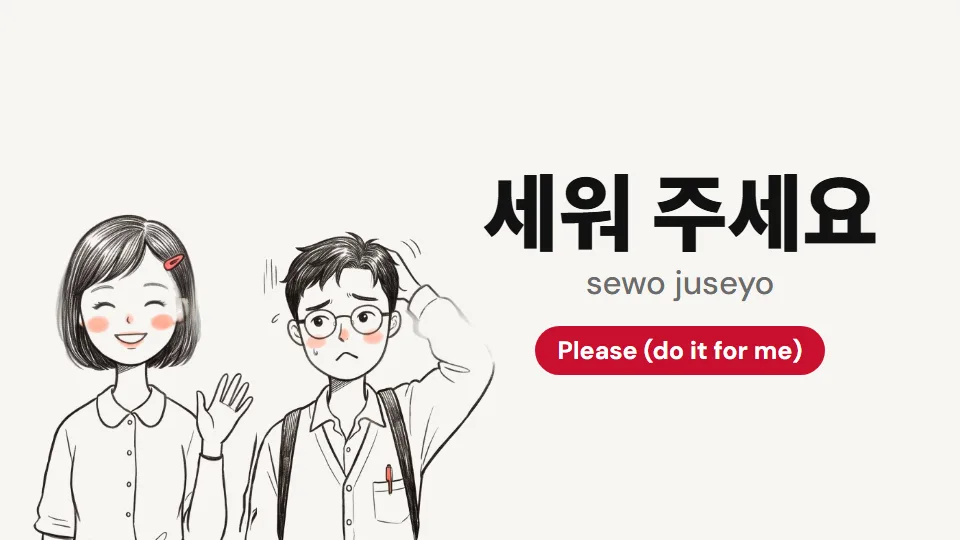
주세요 is the first Korean word most travelers learn: 물 주세요, "water, please". Put it after a verb and it stops meaning "give me" and starts meaning "please do this for me". That covers most of what you ask strangers to do: stop here, make it less spicy, take our photo.
Two kinds of 주세요
| Pattern | Meaning | Example |
|---|---|---|
| noun + 주세요 | please give me (a thing) | 물 주세요. — Water, please. |
| verb + 아/어 주세요 | please do (this) for me | 물 좀 갖다 주세요. — Could you bring some water? |
주다 means "to give," and as a helper verb it adds the idea of doing something for someone's benefit, usually yours. That's why it's the natural way to make a request.
Building it
Start from the polite present you already know (the 아요/어요 rule), drop the 요, and add 주세요.
| Verb | 아요/어요 form | Request |
|---|---|---|
| 세우다 (stop a car) | 세워요 | 세워 주세요: please stop |
| 열다 (open) | 열어요 | 열어 주세요: please open |
| 찍다 (take a photo) | 찍어요 | 찍어 주세요: please take |
| 기다리다 (wait) | 기다려요 | 기다려 주세요: please wait |
| 하다 (do) | 해요 | 해 주세요: please do |
| 바꾸다 (change) | 바꿔요 | 바꿔 주세요: please change |
Any 하다 verb works the same way: 포장하다 → 포장해 주세요, 계산하다 → 계산해 주세요.
Lines for the taxi
| Korean | Romanization | Meaning |
|---|---|---|
| 이 주소로 가 주세요. | i jusoro ga juseyo | Please go to this address. |
| 여기 세워 주세요. | yeogi sewo juseyo | Please stop here. |
| 트렁크 좀 열어 주세요. | teureongkeu jom yeoreo juseyo | Could you open the trunk? |
| 에어컨 좀 켜 주세요. | eeokeon jom kyeo juseyo | Could you turn on the AC? |
| 천천히 가 주세요. | cheoncheonhi ga juseyo | Please drive slowly. |
Lines for the restaurant and shop
| Korean | Romanization | Meaning |
|---|---|---|
| 덜 맵게 해 주세요. | deol maepge hae juseyo | Please make it less spicy. |
| 이거 빼 주세요. | igeo ppae juseyo | Please leave this out. |
| 포장해 주세요. | pojanghae juseyo | To go, please. |
| 계산해 주세요. | gyesanhae juseyo | The bill, please. |
| 봉투에 담아 주세요. | bongtue dama juseyo | Could you put it in a bag? |
Softer still
For a stranger, a favor that takes effort, or anyone clearly older, step up the politeness:
| Form | Feel | Example |
|---|---|---|
| -아/어 주세요 | polite, everyday | 사진 좀 찍어 주세요. |
| -아/어 주시겠어요? | more polite, a question | 사진 좀 찍어 주시겠어요? |
| -아/어 주실 수 있어요? | "would you be able to…?" | 사진 좀 찍어 주실 수 있어요? |
The last one combines this pattern with -(으)ㄹ 수 있다.
Why not just -(으)세요?
-(으)세요 is also polite, but it tells the other person what to do for their own sake: 앉으세요 ("please have a seat"), 들어오세요 ("come in"). Hosts and staff say it to you.
When you want something done for you, it can sound like an order. 여기 세우세요 to a taxi driver sounds like "stop here." 여기 세워 주세요 sounds like "please stop here for me."
Common mistakes
| ✗ | ✓ | Why |
|---|---|---|
| 찍어요 주세요 | 찍어 주세요 | Drop the 요 before 주세요. |
| (to a stranger) 기다리세요 | 기다려 주세요 | -(으)세요 sounds like an instruction. |
| 포장하 주세요 | 포장해 주세요 | 하다 becomes 해. |
The taxi and restaurant lines above are covered in context in the taxi guide and the restaurant guide.