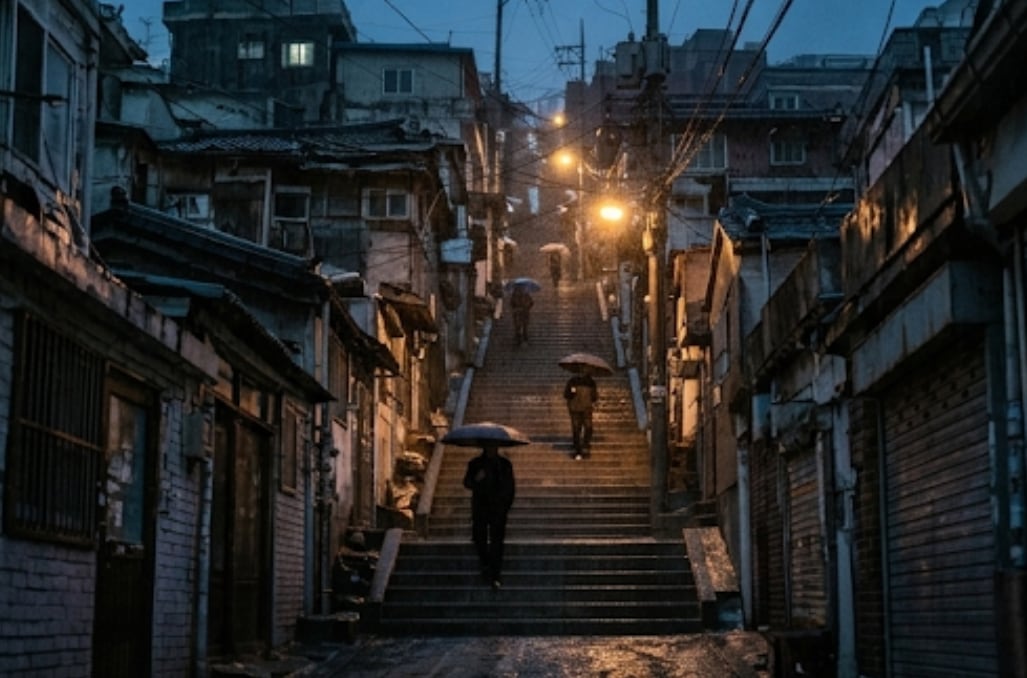
Korean thrillers rarely ask "who did it?" They ask "who made this possible?"
When Parasite won the Palme d'Or in 2019 and Best Picture at the Academy Awards in 2020, many viewers abroad discovered something Korean audiences had known for years: Korean genre cinema blends suspense, dark comedy and sharp social commentary like few others. The violence can be shocking, but the real target is usually the system. Here is how to read the look and logic of Korean thrillers.
Key Takeaways
- Vertical space (stairs, basements, hills) shows who is up and who is down
- Rain and weather expose inequality: the same storm means different things to different homes
- Genre mixing lets comedy and horror sit in the same scene
- Institutions often fail, so ordinary people take justice into their own hands
Up and down: the geography of class
Korean filmmakers love vertical space. In Parasite, the wealthy family lives at the top of a hill in a sleek modern house, while the poor family lives in a 반지하 (banjiha), a semi-basement apartment with a window at street level. Every staircase in the film, and there are many, moves characters between worlds.
These spaces are real. Semi-basement homes are part of Seoul's housing history, and the city's hills often separate older, cheaper neighborhoods from newer ones. Korean audiences recognize the geography instantly, which is why a simple shot of someone walking down steps can feel loaded with meaning.
| Visual element | What it often represents |
|---|---|
| Stairs and hills | Social mobility, or the lack of it |
| Semi-basement windows | Being seen from above, living below street level |
| Heavy rain | A disaster that hits the poor and spares the rich |
| Smell | An invisible line between classes |
| Clean, empty interiors | Wealth as distance from other people |
Rain, mud and the failure of institutions
Rain is a signature of Korean crime cinema. In Bong Joon-ho's Memories of Murder (2003), detectives chase a serial killer through muddy fields and endless downpours, while their methods, forced confessions and fumbled evidence, show a police system unable to protect anyone. The weather becomes a mood of helplessness.
A recurring theme across Korean thrillers is that official institutions, police, courts, corporations, cannot be trusted to deliver justice. Revenge stories like Park Chan-wook's Oldboy (2003) push this to extremes, with characters taking punishment into their own hands. Audiences find these stories cathartic because they speak to real frustrations about power and accountability.
Laughing while it gets worse
What surprises many first-time viewers is the humor. Korean thrillers swing from slapstick to horror within a single scene. A family's clumsy scheme is funny until suddenly it is not. This tonal mix, sometimes described as a "genre cocktail," keeps audiences off balance and makes the darker turns hit harder.
Television has taken the same approach. Squid Game (2021) wrapped brutal survival games in childhood playground imagery, turning debt and competition into a global conversation. The bright pastel sets made the violence more disturbing, not less.
Why these stories travel
Korea industrialized at extraordinary speed, and the pressures that came with it, fierce competition for schools and jobs, housing costs, the gap between generations, are felt in many countries. Korean filmmakers frame these tensions inside gripping genre stories, so audiences abroad recognize their own anxieties without needing a lecture.
That is the lasting power of Korean thrillers. You come for the suspense, and you leave thinking about stairs, basements and who gets to stay dry when the rain comes.
More on Korean culture on screen: K-drama clichés decoded and why K-drama OSTs hit so hard.
Frequently Asked Questions
Why are Korean thrillers so dark? They often channel real frustrations about inequality, competition and institutions, so the stakes feel personal.
What is a banjiha? A semi-basement apartment, partly below street level, featured prominently in Parasite.
Which Korean thrillers should I watch first? Memories of Murder, Oldboy and Parasite are classic starting points.
Why do Korean films mix comedy and violence? Blending genres keeps viewers off balance, which makes the serious moments land harder.