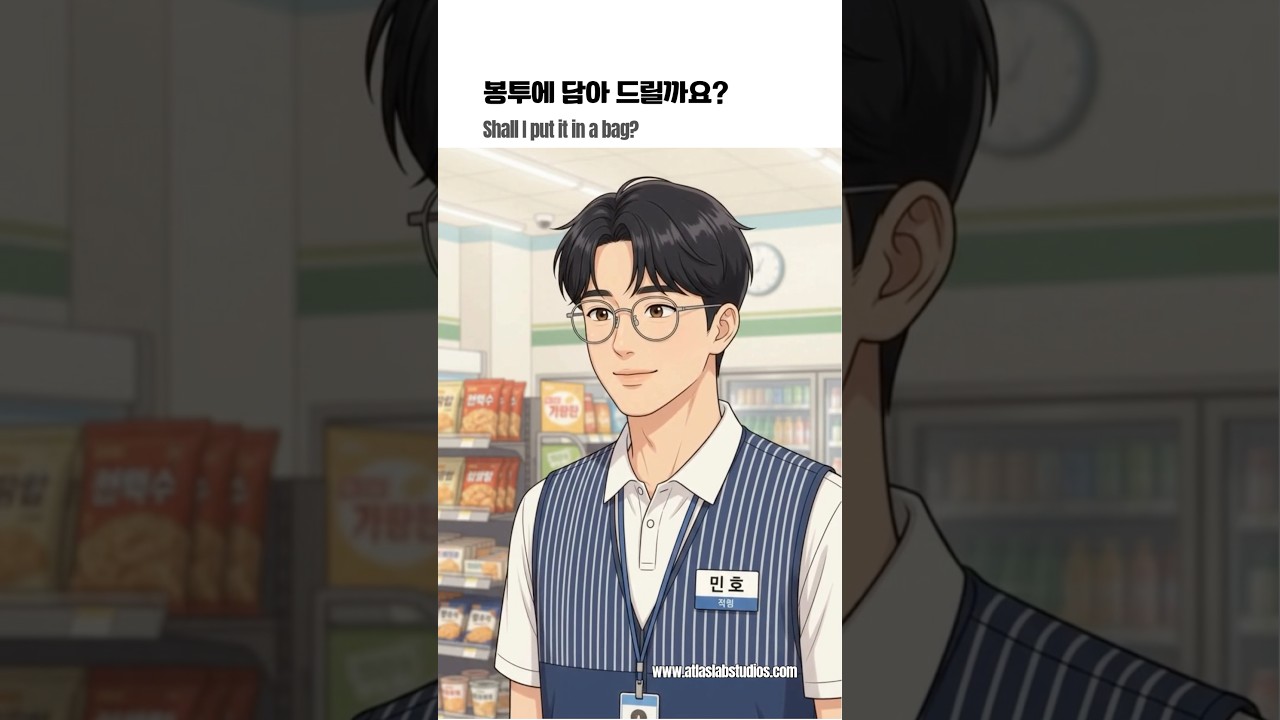
You put your things on the counter. The staff scans them, says something, and looks at you expectantly. You have no idea what was asked.
It's almost always about the bag.
The exchange
계산할게요 — gye-san-hal-ge-yo — "I'd like to pay"
You don't strictly need to say this. Putting your items on the counter is enough. But it starts the interaction cleanly, and it's the same phrase you'd use at a restaurant counter.
Then comes the question:
봉투에 담아 드릴까요? bong-tu-e dam-a deu-ril-kka-yo? "Shall I put it in a bag?"
Some staff shorten it to 봉투 필요하세요? (bong-tu pil-yo-ha-se-yo?) — "Do you need a bag?"
Answering
| Korean | Romanization | Meaning |
|---|---|---|
| 네, 담아주세요 | ne, dam-a-ju-se-yo | Yes, please |
| 괜찮아요 | gwaen-chan-a-yo | No thanks |
| 그냥 주세요 | geu-nyang ju-se-yo | I'll take it as is |
괜찮아요 is the most useful word on this page. It means "it's fine" and works as a polite no to almost any offer — a bag, a receipt, a straw, help finding something.
Bags cost money
봉투 백 원이에요 — "The bag is 100 won"
Korea restricted free plastic bags, so convenience stores and supermarkets charge for them. Usually 100 to 200 won, added to your total.
That's why staff ask instead of bagging automatically. It isn't a courtesy question — they need your permission to charge you.
The trash bag trick
At many stores you can buy a 종량제 봉투 (jong-nyang-je bong-tu) — an official waste-disposal bag — instead of a regular plastic one.
It costs more, but Korean household trash has to go out in these bags, so if you're staying in an apartment or Airbnb you'll need them anyway. Carrying your snacks home in one means you're not buying a bag twice.
종량제 봉투로 주세요 — "Give me a waste-disposal bag instead"
Only useful if you're staying a while. For a short trip, skip it.
Other things you'll be asked
Once you recognize the shape of these questions, the rest of the counter goes smoothly.
영수증 필요하세요? — "Do you need a receipt?" → 네 or 괜찮아요
포인트 적립하세요? — "Do you want to collect points?" → 괜찮아요 (you need a Korean membership card)
데워 드릴까요? — "Shall I heat it up?" → for anything microwavable. 네, 데워주세요
That last one is worth knowing. Convenience stores will microwave your food for you, and they'll ask if you bought something that's meant to be warm.
Paying
카드요 — ka-deu-yo — "By card"
Card works everywhere with no minimum. You'll usually insert or tap it yourself at the reader facing you.
Foreign cards work at most stores, though very small branches occasionally reject them. There's no tipping.
What to actually do
- Put your items on the counter
- When asked about a bag, say 네, 담아주세요 or 괜찮아요
- 괜찮아요 also handles the receipt and points questions
- Tap your card at the reader
- Grab chopsticks if you bought anything that needs them
Two words — 네 and 괜찮아요 — get you through the entire counter.
The whole exchange takes twenty seconds and happens several times a day in Korea. K-PATTO teaches 300+ phrases like these through a webtoon story set in Seoul, with native audio on every line. The first ten episodes are free.