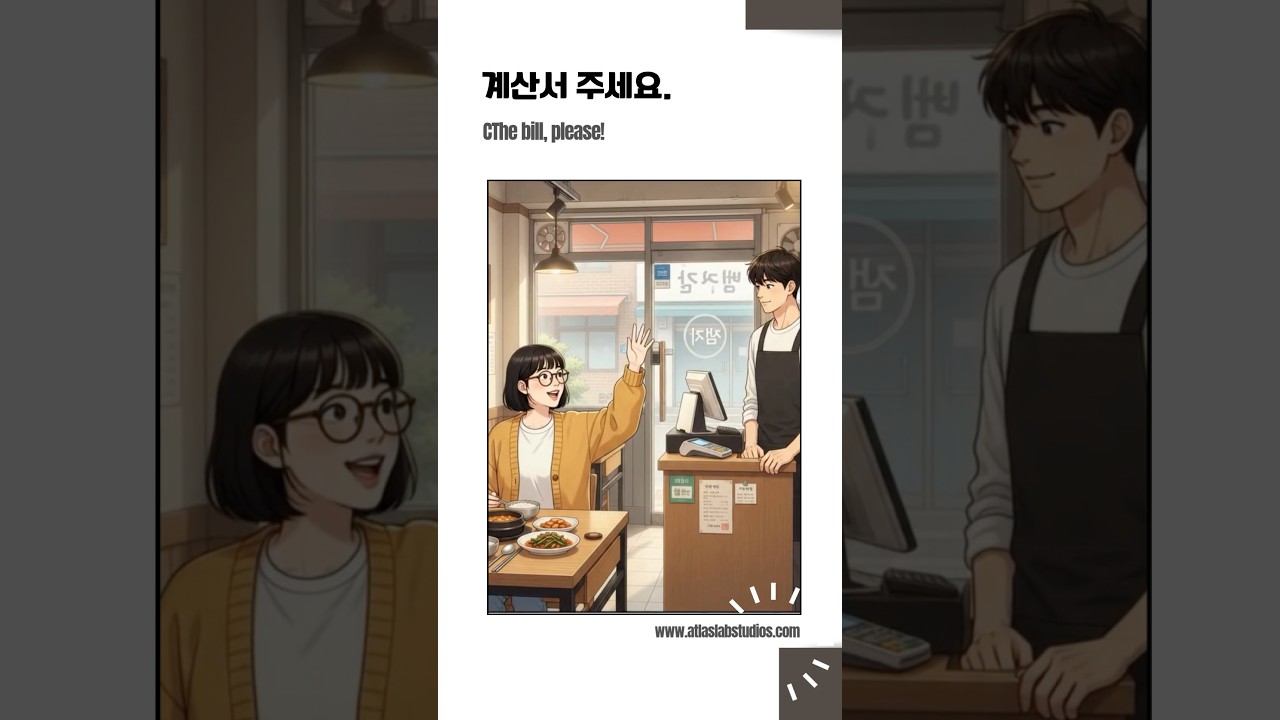
You've finished eating. You raise your hand and ask for the bill. Staff glance over and go back to what they were doing. Five minutes pass.
Nothing is wrong. You're just waiting in the wrong place.
The counter, almost always
In most Korean restaurants, you pay at the counter near the entrance, not at your table.
There's usually a slip of paper already sitting on your table — placed there when your food arrived. That's your bill. You pick it up, walk to the counter, and pay on your way out.
Nobody brings a card machine to your seat. Nobody comes to collect payment. The whole system assumes you'll get up.
Here's what that looks like:
The one phrase you need
계산할게요 — gye-san-hal-ge-yo — "I'd like to pay"
Say it as you approach the counter, slip in hand. That's the entire transaction.
If there's no slip on your table, tell them your table number, or just say 계산할게요 and they'll ask.
| Korean | Romanization | Meaning |
|---|---|---|
| 계산할게요 | gye-san-hal-ge-yo | I'd like to pay |
| 계산서 주세요 | gye-san-seo ju-se-yo | The bill, please |
| 카드요 | ka-deu-yo | By card |
| 현금이요 | hyeon-geum-i-yo | In cash |
| 영수증 주세요 | yeong-su-jeung ju-se-yo | Receipt, please |
계산서 주세요 is the phrase most textbooks teach, and it isn't wrong — but in Korea it usually gets you pointed toward the counter rather than handed a bill.
Splitting the bill
Korea has a strong culture of one person paying for the group, but splitting is normal too, especially among younger people.
따로 계산해 주세요 — tta-ro gye-san-hae ju-se-yo — "separate checks, please"
Say it before they ring anything up. Most places can split by card without trouble, though a busy restaurant at peak hours may ask you to sort it out yourselves.
같이 계산할게요 — ga-chi gye-san-hal-ge-yo — "I'll pay for all of it" — if you're covering the table.
Card is fine everywhere
Korea is close to cashless. Card works in almost every restaurant, including small family-run places, and there's no minimum spend.
You'll usually be asked:
카드요, 현금이요? — ka-deu-yo, hyeon-geum-i-yo? — "Card or cash?"
Answer 카드요 and hand it over. Foreign cards work at most places, though very small or old establishments occasionally reject them. Having some cash as backup is sensible but rarely necessary.
No tipping
There's no tipping in Korea. Not at restaurants, not in taxis, not at cafes.
Leaving money on the table will get someone chasing you down the street to return it. The price on the menu is the price you pay, tax included.
The exceptions
A few situations do work differently.
Cafes and fast food. You pay first, before you get your food. Order at the counter, pay, then wait for your number.
Some upscale restaurants. Fine dining and hotel restaurants often bring the bill to your table like a Western restaurant.
Bars and pubs. You typically settle at the end, at the table or the counter depending on the place.
Tabletop tablets. Newer chains have ordering tablets at each table, and some let you pay through them directly.
When in doubt, look for a counter near the door. If there's a card reader on it, that's where you pay.
What to actually do
- Finish eating. Don't wait for anyone to come
- Look for a slip of paper on your table
- Take it to the counter by the entrance
- Say 계산할게요
- Answer 카드요 and you're done
The silence after your meal isn't the staff ignoring you. They're waiting for you to walk over.
계산할게요 is one of those short phrases that removes an entire moment of confusion. K-PATTO teaches 300+ of them through a webtoon story set in Seoul, with native audio on every line. The first ten episodes are free.