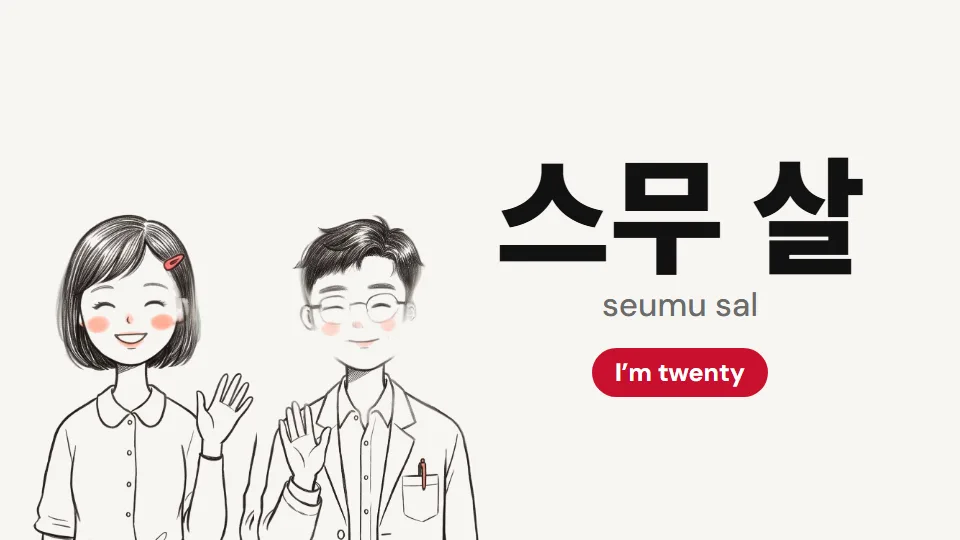
Age matters more in Korean conversation than in English: it decides how people address each other and which speech level feels natural, so it comes up within minutes of meeting someone. You need three things: how to say an age, how to ask politely, and which age people mean since Korea changed its official count.
Saying your age: native number + 살
In everyday speech, age is a native Korean number + 살 (sal, "years of age"). 살 is a counter, so the counter rules apply: 1–4 and 20 shorten.
| Age | Korean | Romanization |
|---|---|---|
| 1 | 한 살 | han sal |
| 4 | 네 살 | ne sal |
| 20 | 스무 살 | seumu sal |
| 21 | 스물한 살 | seumulhan sal |
| 25 | 스물다섯 살 | seumuldaseot sal |
| 30 | 서른 살 | seoreun sal |
| 40 | 마흔 살 | maheun sal |
| 50 | 쉰 살 | swin sal |
The decades are where learners stumble, because native tens have their own words: 열 (10), 스물 (20), 서른 (30), 마흔 (40), 쉰 (50), 예순 (60).
세: the formal version
On forms, in news reports and in announcements you'll see 세 (se) with Sino-Korean numbers: 25세 (이십오 세), 만 65세 이상 ("65 and over"). It means the same thing as 살, just in a written, official register. You rarely need to say it, but you'll read it everywhere.
Asking politely
The question changes with the person you're asking.
| Who you're asking | Korean | Romanization |
|---|---|---|
| a child, or a friend your age | 몇 살이에요? | myeot sarieyo? |
| an adult, a stranger, someone new | 나이가 어떻게 되세요? | naiga eotteoke doeseyo? |
| someone clearly older | 연세가 어떻게 되세요? | yeonsega eotteoke doeseyo? |
Plenty of Koreans skip the number and ask the birth year instead: 몇 년생이에요? ("what year were you born?"). The answer is the last two digits: 구십육 년생이에요 ("I was born in '96"). Because the year doesn't change between birthdays, it's the cleanest way to work out who is older.
Answering and following up
- 스물여덟 살이에요. — I'm 28.
- 만으로 서른이에요. — I'm 30 in international age.
- 동갑이네요! — We're the same age!
- 제가 한 살 많아요. — I'm a year older.
- 제가 동생이네요. — So I'm the younger one.
Being the same age (동갑) is often the moment people suggest dropping the polite endings. The politeness levels guide covers when that switch is safe.
Common mistakes
| ✗ | ✓ | Why |
|---|---|---|
| 이십 살, 삼십 살 | 스무 살, 서른 살 | 살 takes native numbers. |
| 스물 살, 하나 살 | 스무 살, 한 살 | Native numbers shorten before 살. |
| (to an elder) 몇 살이에요? | 연세가 어떻게 되세요? | 몇 살 sounds like talking to a child. |
| 스무 세, 이십 살 | 스무 살, 이십 세 | Pair 살 with native, 세 with Sino-Korean. |
The two number systems guide shows where else native and Sino-Korean numbers split.