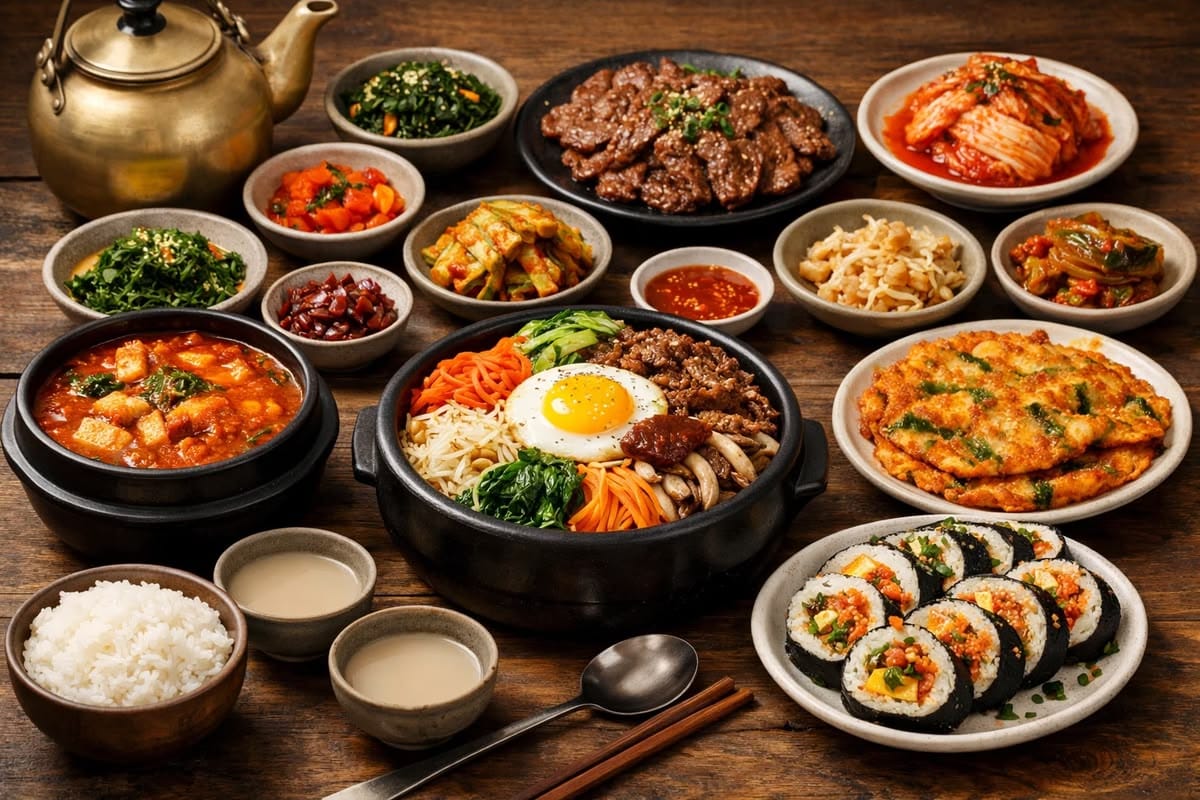
Korean menus follow a few simple patterns: the last word of a dish tells you how it's cooked, side dishes are free and never listed, and some dishes come with rice while others don't. Learn the suffixes and four ordering rules below and a handwritten wall menu becomes easy.
At a glance
- Side dishes (banchan): free, refillable and never on the menu; anything with a price is a main dish or an add-on
- Rice: stews and soups usually include a bowl; BBQ and stir-fries usually don't, so order 공기밥 (1,000–2,000 KRW)
- 2인분 이상: tabletop dishes like BBQ and hot pots usually need at least two portions
- Service: press the table bell when you're ready, find cutlery in the drawer under the table, and pay at the counter
- Avoid: tipping; it isn't part of Korean dining
Decode the dish name by its last word
Most dish names end in a word that tells you how the food is cooked. Recognize it and you know roughly what will arrive.
| Ending | What to expect | Examples |
|---|---|---|
| ~찌개 jjigae | A thick, rich stew, often with tofu and a fermented paste | 김치찌개 kimchi stew, 된장찌개 soybean paste stew, 순두부찌개 soft tofu stew |
| ~탕 tang / ~국 guk | Soup, usually served boiling hot in an earthenware bowl | 갈비탕 short rib soup, 삼계탕 ginseng chicken soup, 해장국 hangover soup |
| ~구이 gui | Grilled meat or fish | 삼겹살구이 pork belly, 고등어구이 grilled mackerel |
| ~볶음 bokkeum | Stir-fried over high heat, often spicy | 제육볶음 spicy pork, 오징어볶음 spicy squid |
| ~찜 jjim | Braised or steamed until tender | 갈비찜 braised short ribs, 안동찜닭 Andong braised chicken |
| ~전골 jeongol | A shallow hot pot cooked at your table to share | 만두전골 dumpling hot pot, 곱창전골 beef tripe hot pot |
For the full difference between the soups and stews, see guk vs tang vs jjigae vs jeongol.
The ordering rules nobody explains
2인분 이상 means "two portions minimum". At Korean BBQ, dakgalbi and hot pot restaurants, prices are per portion (1인분), and most places want at least two to light the grill. Eating alone? Order two for yourself: 2인분 주세요 (iinbun juseyo), "two portions, please". The Korean BBQ guide explains the cuts.
Cutlery is in the drawer. Staff rarely bring spoons and chopsticks. Many restaurants keep them, with napkins, in a slide-out drawer under the table edge or in a box on the table.
Save the sauce for fried rice. After BBQ, dakgalbi or tteokbokki, leave some sauce in the pan and ask: 볶음밥 하나 볶아 주세요 (bokkeumbap hana bokka juseyo), "please make one fried rice". Staff fry rice, seaweed and sesame oil right in your pan.
Refills are often self-service. A sign reading 추가 반찬은 셀프입니다 means extra side dishes are self-service: take your empty dish to the refill bar and help yourself. 물은 셀프 means water is self-service too. See are side dishes free? for asking staff instead.
Want the whole order written out for you? The Korean Restaurant Ordering Phrase Builder turns your dishes and requests into Korean you can show staff.
Add-ons you'll see on every menu
| Korean | Romanization | When to order |
|---|---|---|
| 공기밥 | gonggibap | A bowl of rice, about 1,000–2,000 KRW, when your dish doesn't include one |
| 사리 추가 | sari chuga | Extra noodles or rice cakes in a stew: 라면사리 ramyeon, 당면사리 glass noodles, 떡사리 rice cakes |
| 음료수 | eumnyosu | Soft drinks; 사이다 (saida, "cider") means lemon-lime soda |
| 계란찜 | gyeranjjim | Fluffy steamed egg, a mild side for spicy stews and BBQ |
Checking whether rice is included
저기요, 된장찌개 하나랑 공기밥 하나 주세요.
Jeogiyo, doenjangjjigae hanarang gonggibap hana juseyo.
Excuse me, one soybean paste stew and one rice, please.
찌개에 밥 하나 기본으로 나와요.
Jjigaee bap hana giboneuro nawayo.
The stew already comes with one rice.
아, 그럼 찌개만 주세요.
A, geureom jjigaeman juseyo.
Oh, then just the stew, please.
Do
- Press the call bell on your table, or say 저기요 (jeogiyo), when you're ready to order
- Check the drawer under the table for spoons and chopsticks
- Take the bill slip to the counter to pay when you leave
- Say 잘 먹었습니다 (jal meogeotseumnida), "I enjoyed the meal", on your way out
Don't
- Leave a tip; staff may chase you to return it
- Stand chopsticks upright in your rice; it resembles incense at a memorial
- Lift your rice or soup bowl to your mouth; it stays on the table
- Wait for water if the sign says 물은 셀프
Frequently Asked Questions
How do I pay if nobody brings the bill? In most casual restaurants you pay at the counter by the exit. Staff leave a slip or receipt on your table; take it to the counter and pay by card. Places with table tablets sometimes let you pay at the table. See pay at the table or the counter?
Are side dishes really free and refillable? Yes. Basic banchan like kimchi, bean sprouts and pickled radish come with the meal. Ask for more with 이거 더 주세요 (igeo deo juseyo), "more of this, please", or use the self-service bar.
What if the restaurant uses a tablet to order? Many restaurants now have tablets on each table. Look for a language or globe button to switch to English; some let you pay by card on the tablet, others send you to the counter.